


Google Trends shows you how interest in a search term moves over time, across different regions and against related queries. It reports relative interest on a 0 to 100 scale so it’ll be difficult to tell the search volume, intent or how many people are actually looking. A term can look strong and still be small.
I tested it on one subject: website builders. On September 18, 2026, the term wasn’t trending, so I built the test from scratch on the Explore page. I started with a worldwide view of the past 24 hours, all categories and web search, then changed one setting at a time: geography then time period. I also pulled the related queries to find other terms worth comparing.
I started with the worldwide view, which looked solid, and used it as my baseline. The United States and United Kingdom held up. In Canada and Australia, which related terms showed up depended on the time window. Here’s how to run the same test, what changed my read and the content ideas I built from it.
How to use Google Trends for keyword research
- Open Google Trends and go to Explore.
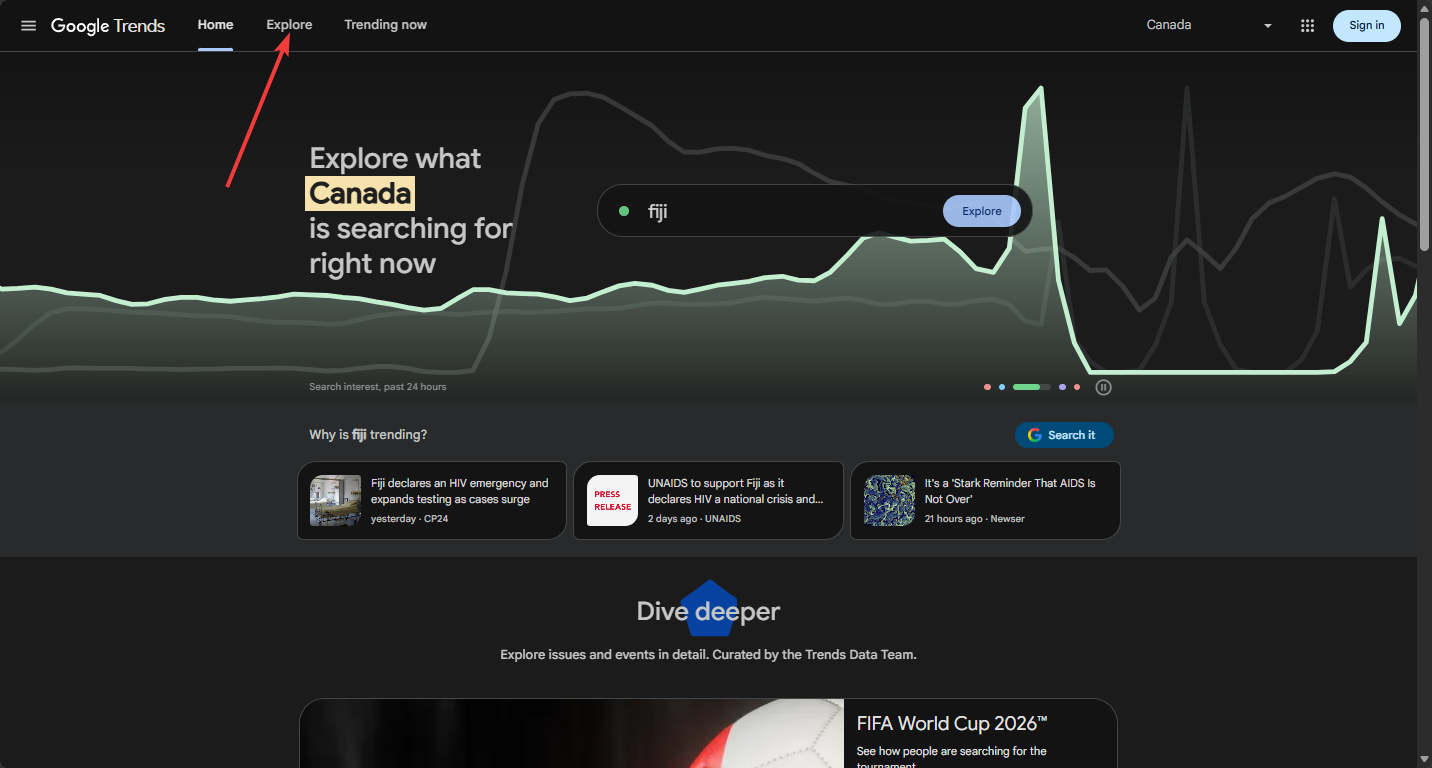
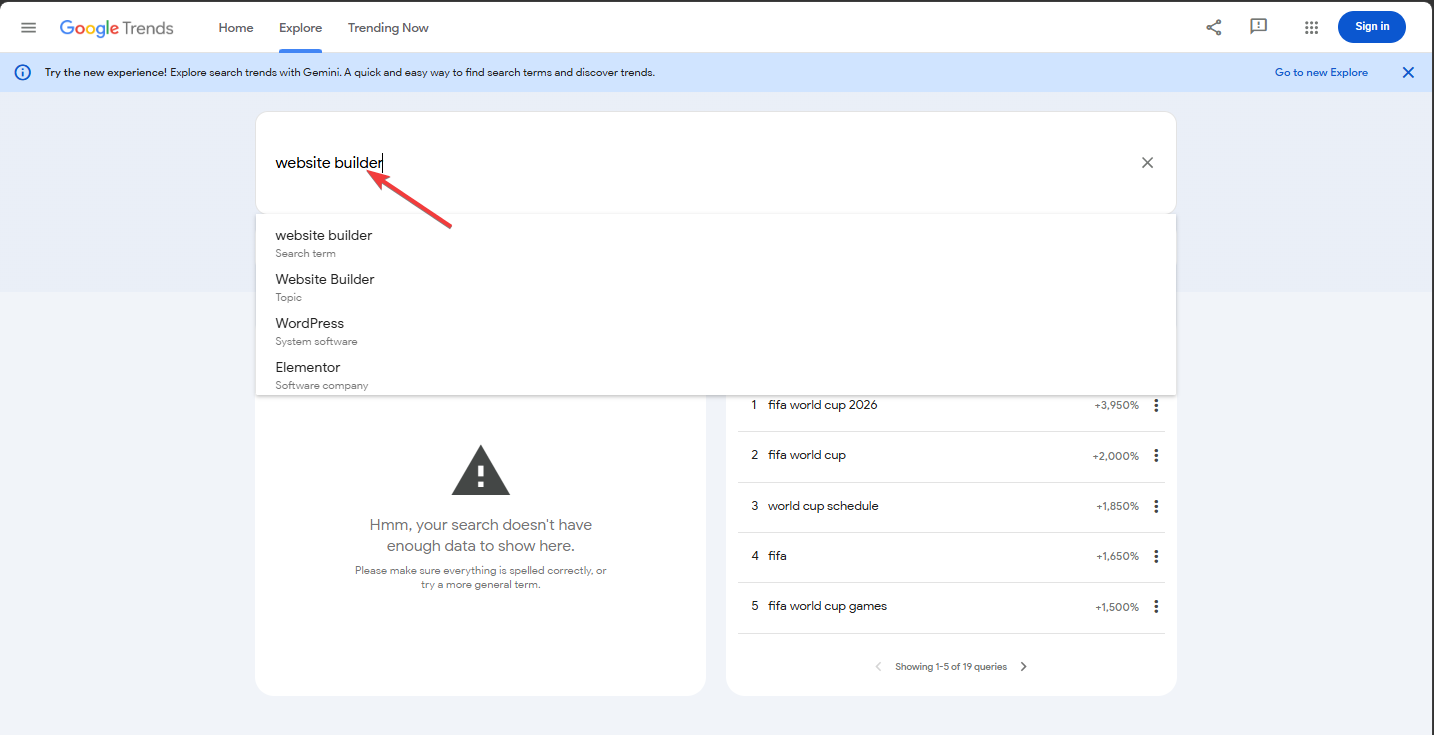
- Enter your main keyword. If the dropdown offers both a search term and a topic, note both, since you’ll compare them later.
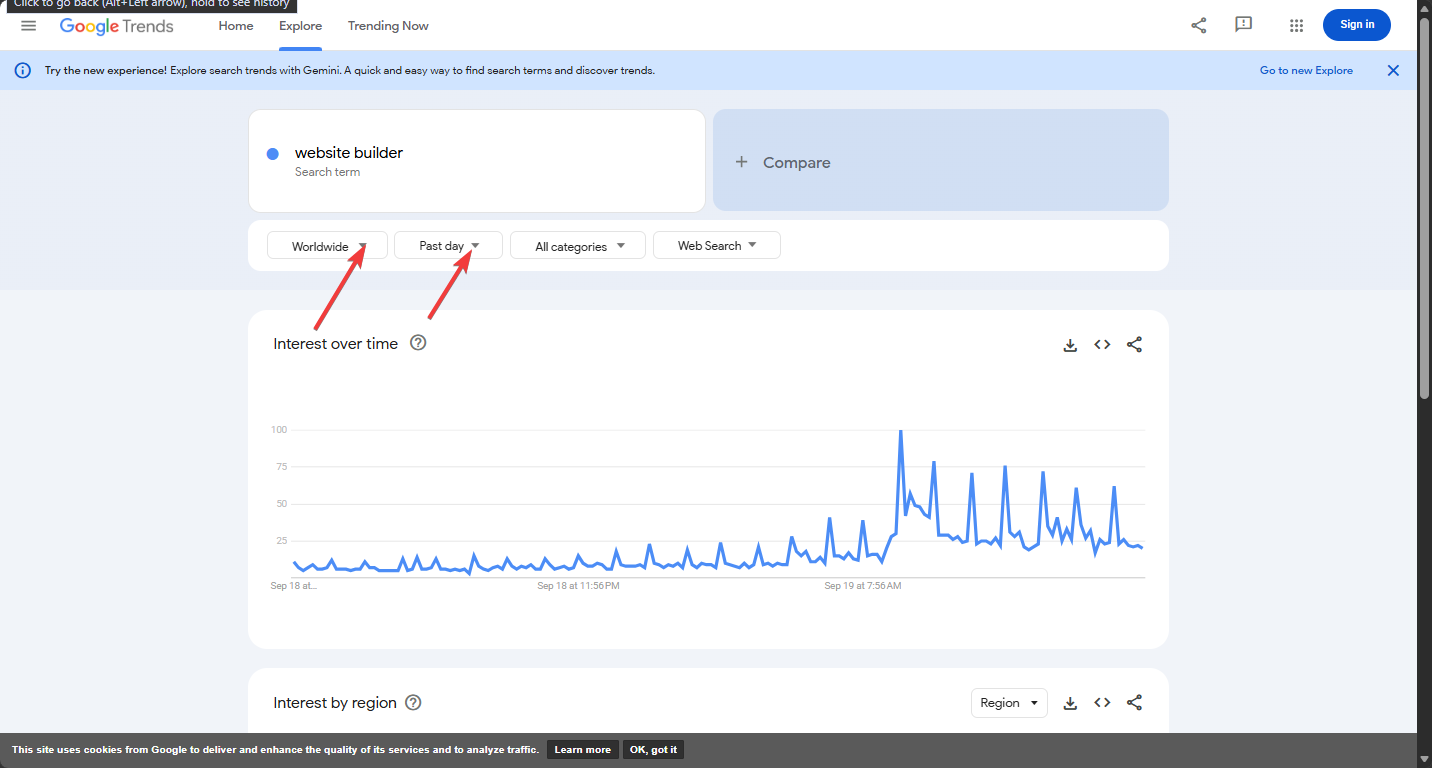
- Set a starting point: one country, one date range, all categories and web search.
- Add up to four related terms to compare, for five in total.
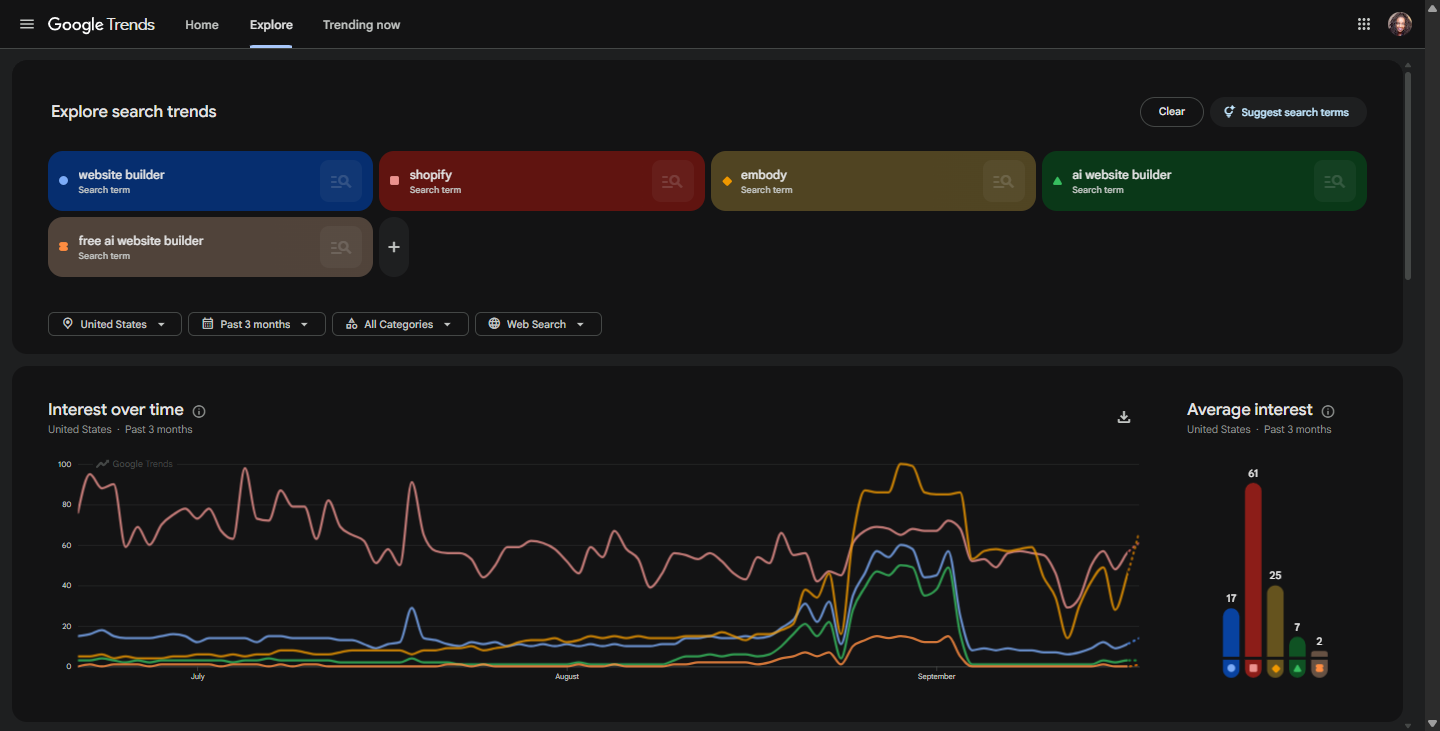
- Read the chart as relative interest on a 0 to 100 scale. It isn’t search volume, so a term can look strong and still be small.
- Change one setting at a time (region, then time period, then search term versus topic) and note whether your read of the keyword changes.
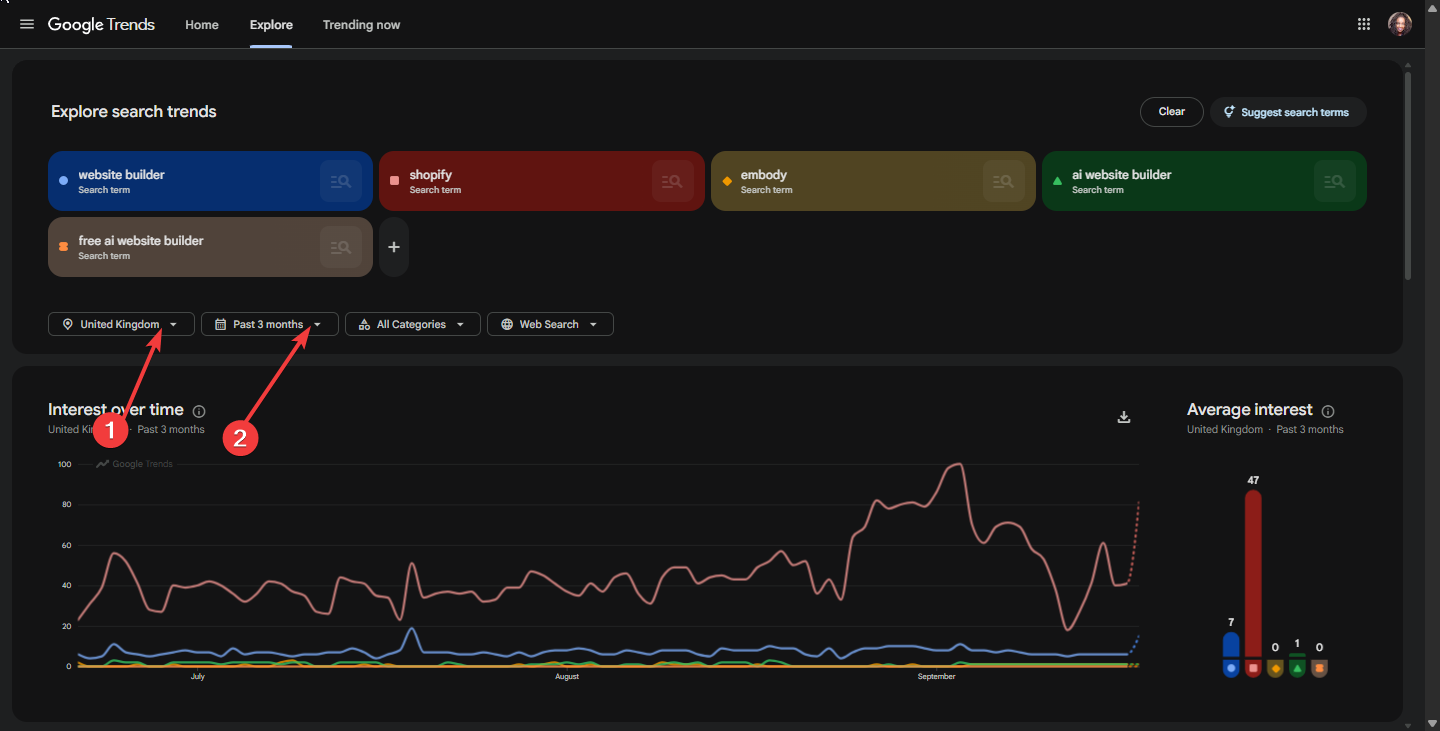
- Continue adjusting the filters to get a multi-angle view of search interest across different regions and timeframes.
Establishing a baseline
I started with the default categories: Region set to worldwide, timeframe as past 24 hours, all categories and search as web search.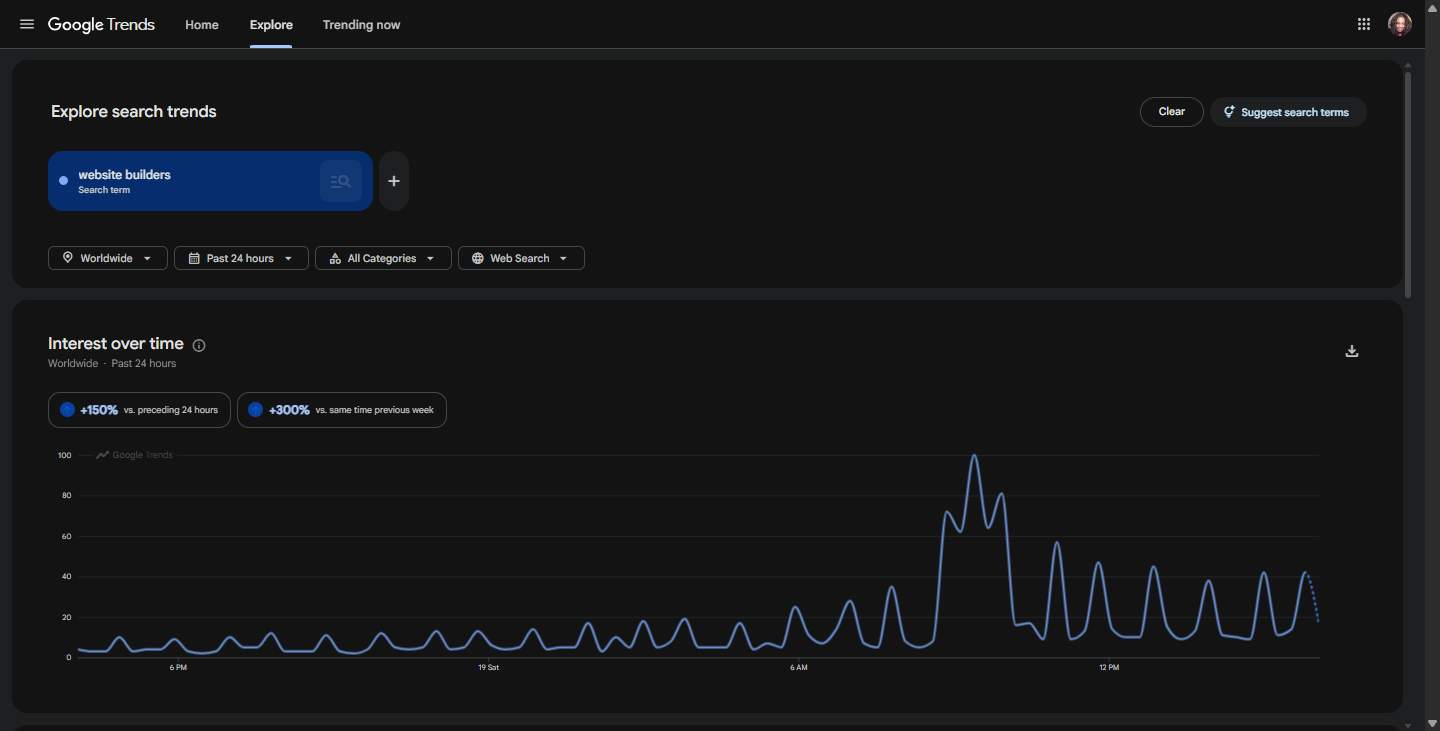
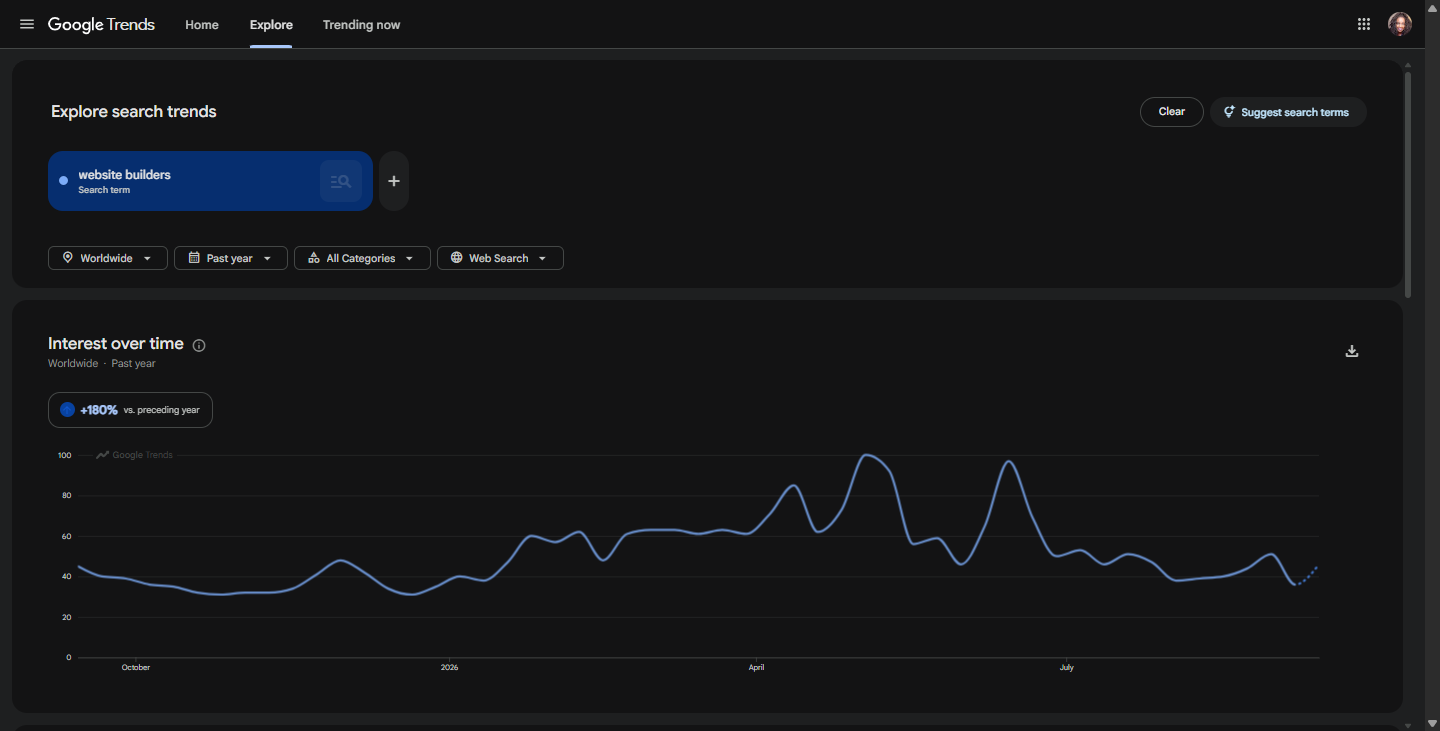
From this view, the term maintains steady, recurring search interest throughout the day. For the past year view, the search interest grew significantly compared to the previous year and a sharp peak between April and May 2026.
For the five-year view, overall search interest increased by 250% compared to the preceding 5-year period.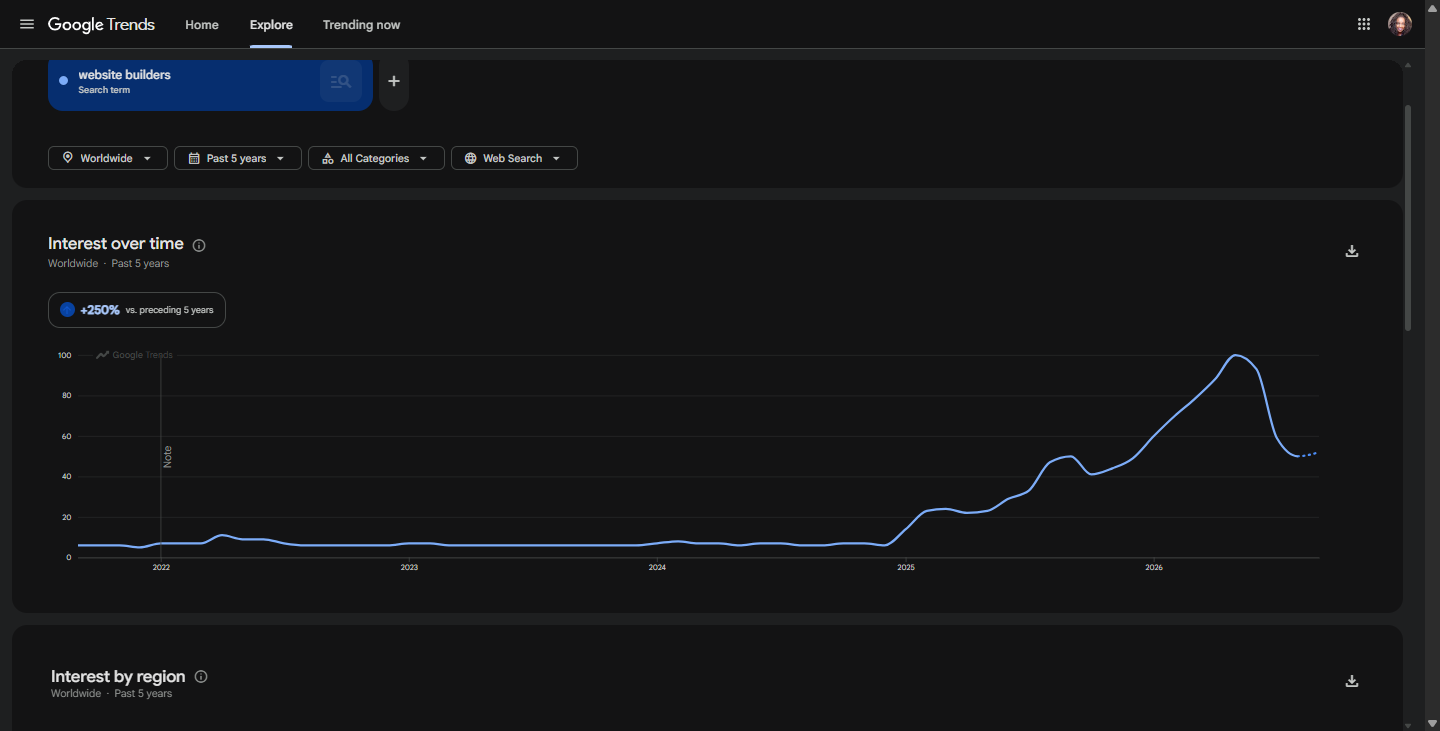
This establishes a baseline increase in relative search interest. And while we established a baseline, it’s important to note that trends’ percentage changes are relative. While a term can post triple-digit growth, its interest score could be lower which means it’s growing off a small base, not going mainstream.
Trend across regions
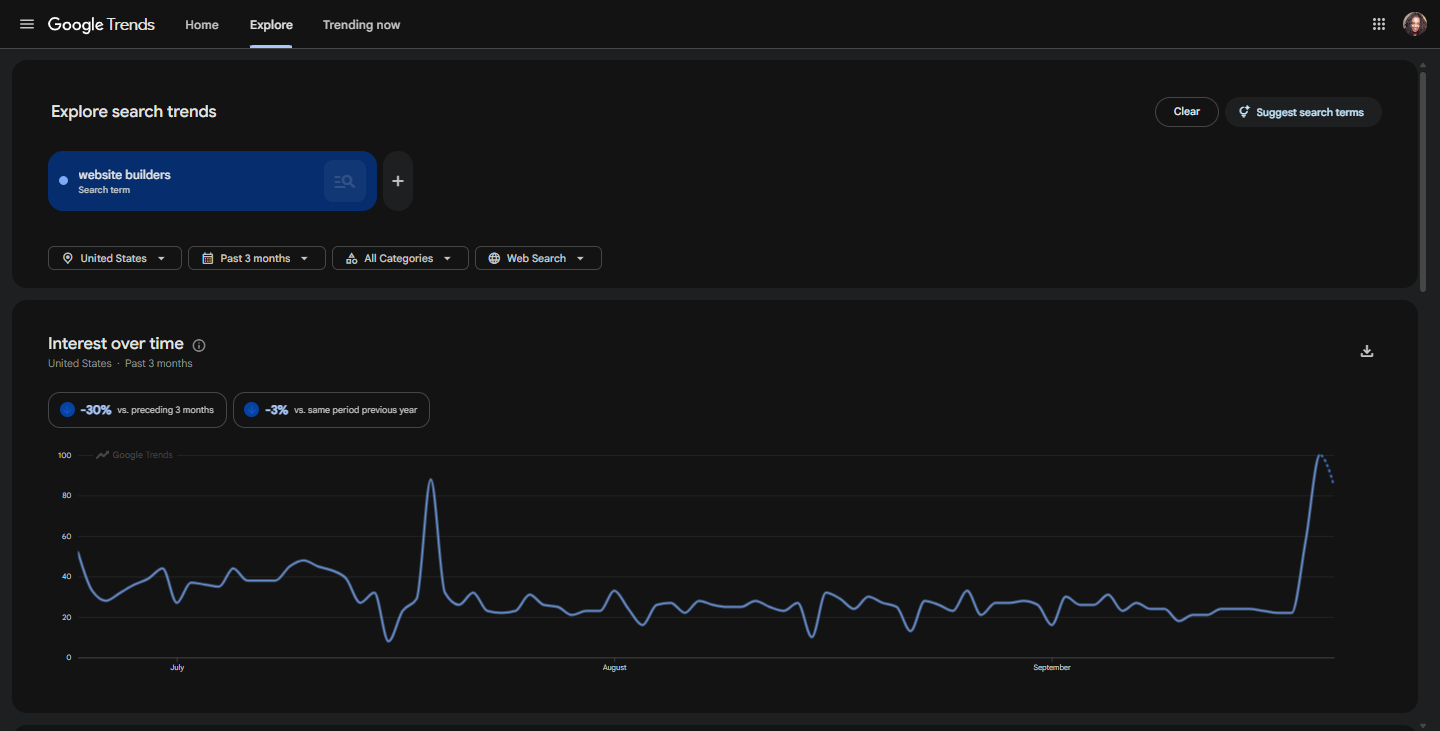
For this tests, I chose four regions: The United States, The United Kingdom, Australia and Canada.In the United States, search interest remained mostly stable even though the interest had dropped 3% in the same period previous year for the three-month view.
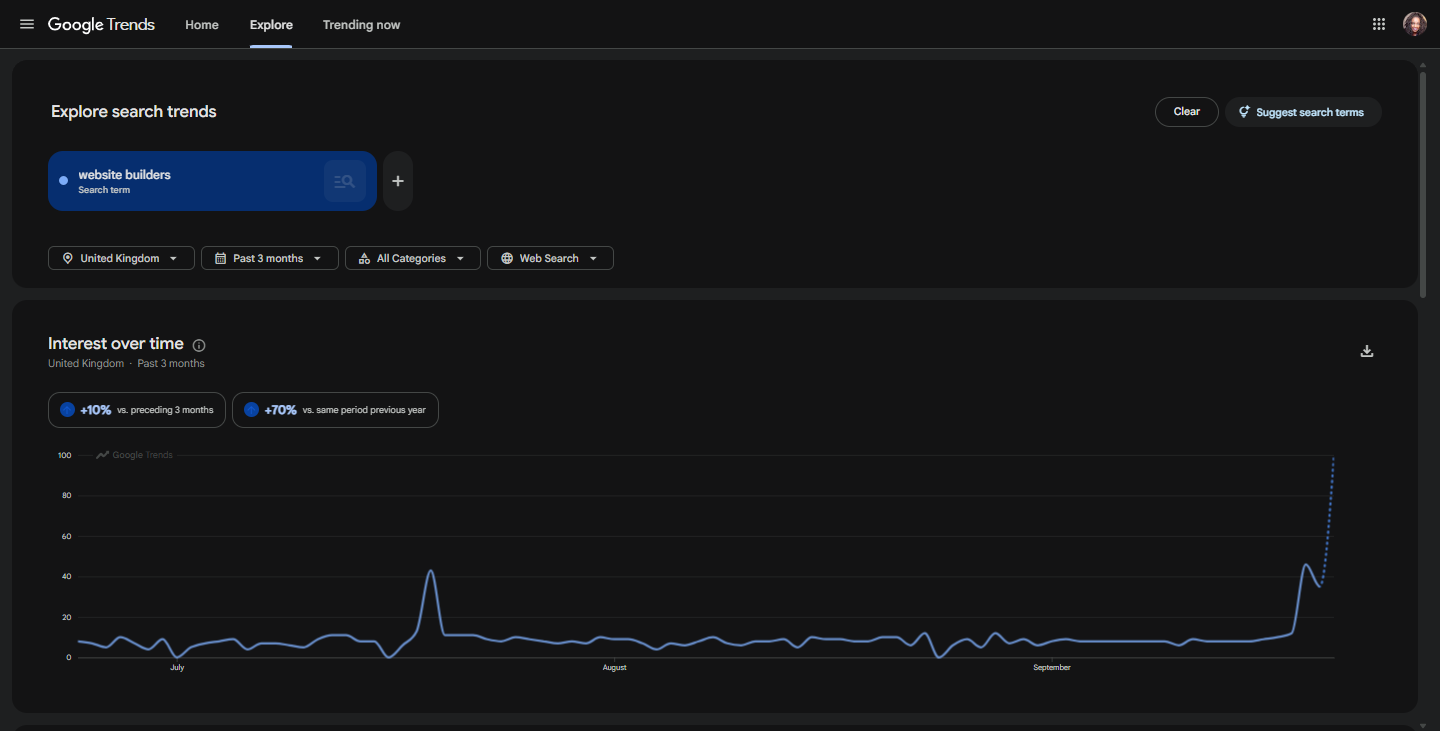
In the United Kingdom under the same setting, the search interest had ballooned up to 70% compared to the same period in the previous year and up 10% in the lst three months.
Australia had a 90% jump compared to the same time last year and Canada had a 200+% increase compared to the same time in the past year but a drop of 70% in the last three months.
Trend over time
Having established relative search interest in the four select regions, it was time to adjust the time frame and see whether the search interest held up. This is how it performed over time in the last three months, past year and past five years across the four regions compared to a previous equivalent period.
| Region | Past 90 days | Past Year | Past Five Years |
| The United States | Down 3% | Up 120% | Up 200% |
| The United Kingdom | Up 70% | Up 250% | Up 250% |
| Australia | Up 90% | Up 350% | Up 250% |
| Canada | Up 200% | Up 250% | Up 60% |
While these percentages show a mostly upward trajectory within a region, they don’t reveal which market is bigger. A dramatic surge on a Google Trends chart simply means interest is growing faster relative to that specific country’s total search. Even when a spike in the number looks strong, it doesn’t necessarily make the region a strong market.
Related queries: Does the search interest level hold up?
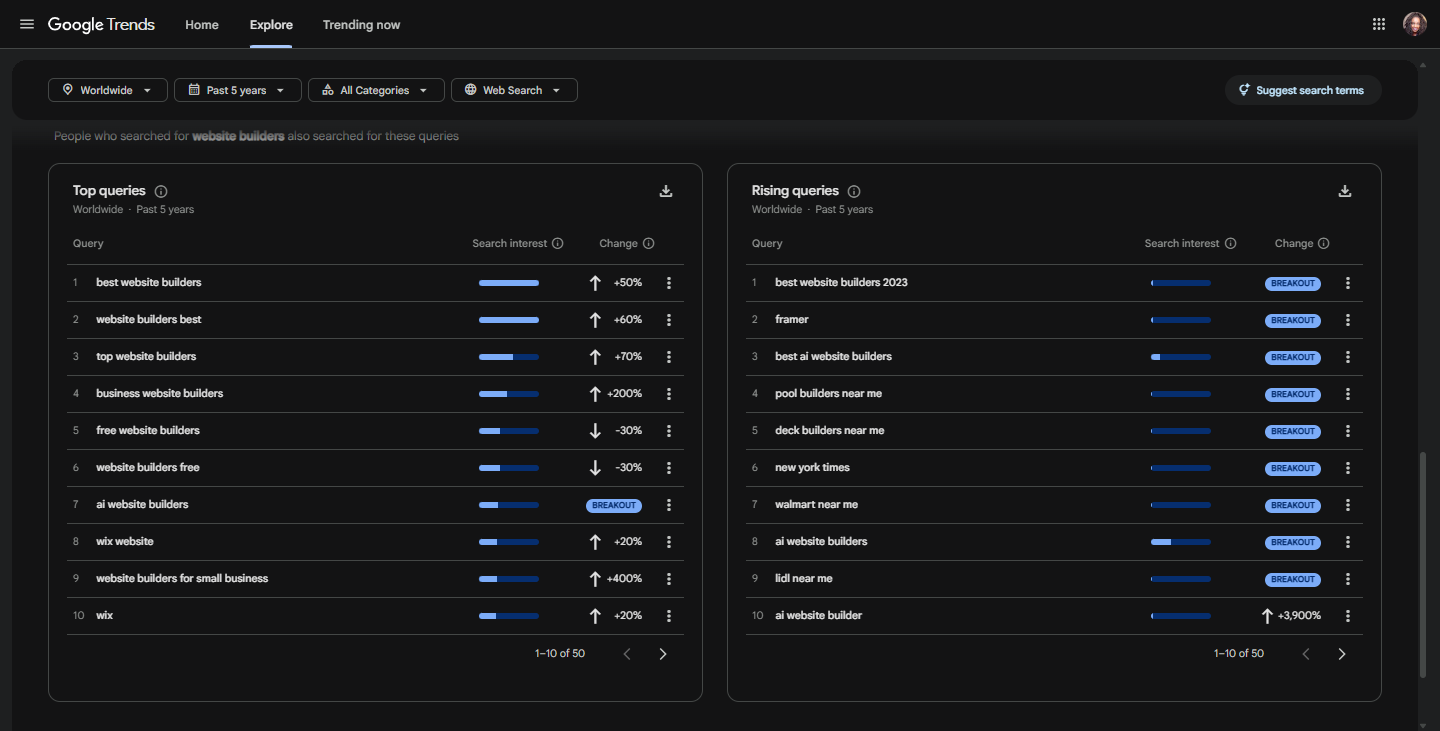
With the baseline set, I turned to related queries to find more specific terms to test. For the related terms, I scrolled down to the top queries list and picked four terms that had an interest score of above 50%. These were: best website builders, ai website builders, business website builders, and website builders for small business. Google Trends also flagged AI website builders as a breakout query, meaning it was rising particularly quickly rather than simply being a high-interest term. Trends also flags high-interest rising queries, which need their own scrutiny. For how to vet a breakout query before you act on it, see our companion piece on Google Trends for trending products.
Regionally, performance varied significantly. The search terms best website builders and business website builders saw relatively higher search interest in the United States and United Kingdom compared to Australia and Canada across the three months, past year and past five years.
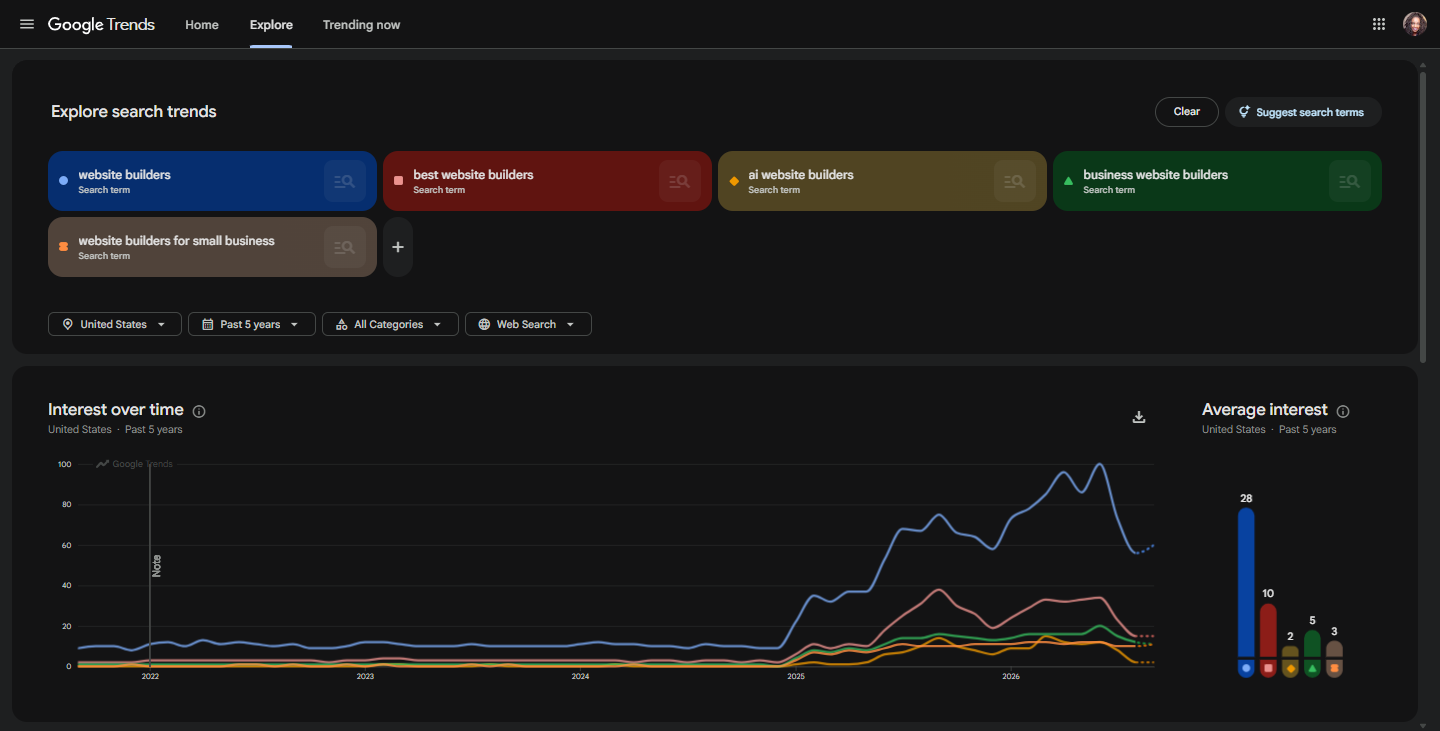
Similarly, website builders for small business only generated enough search interest to register in the United States and United Kingdom across all timeframes.
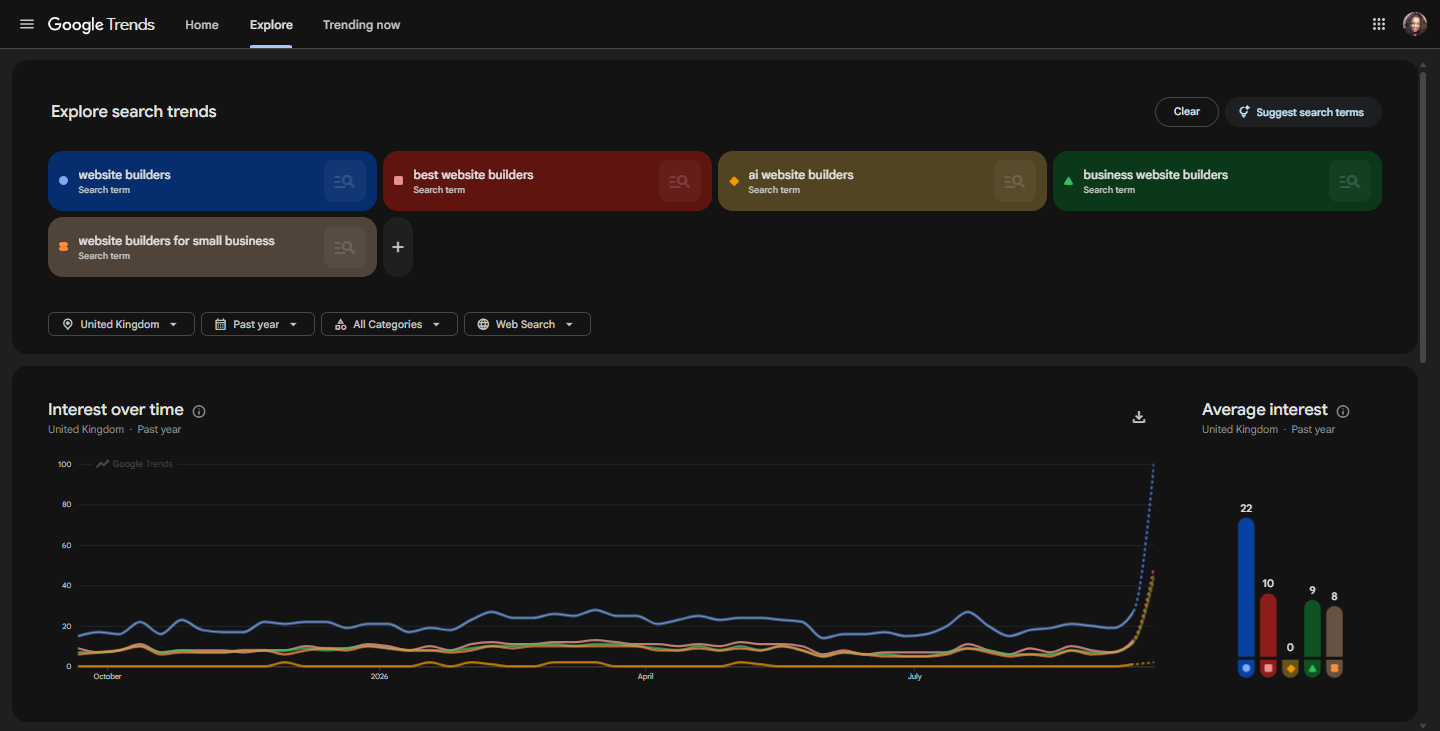
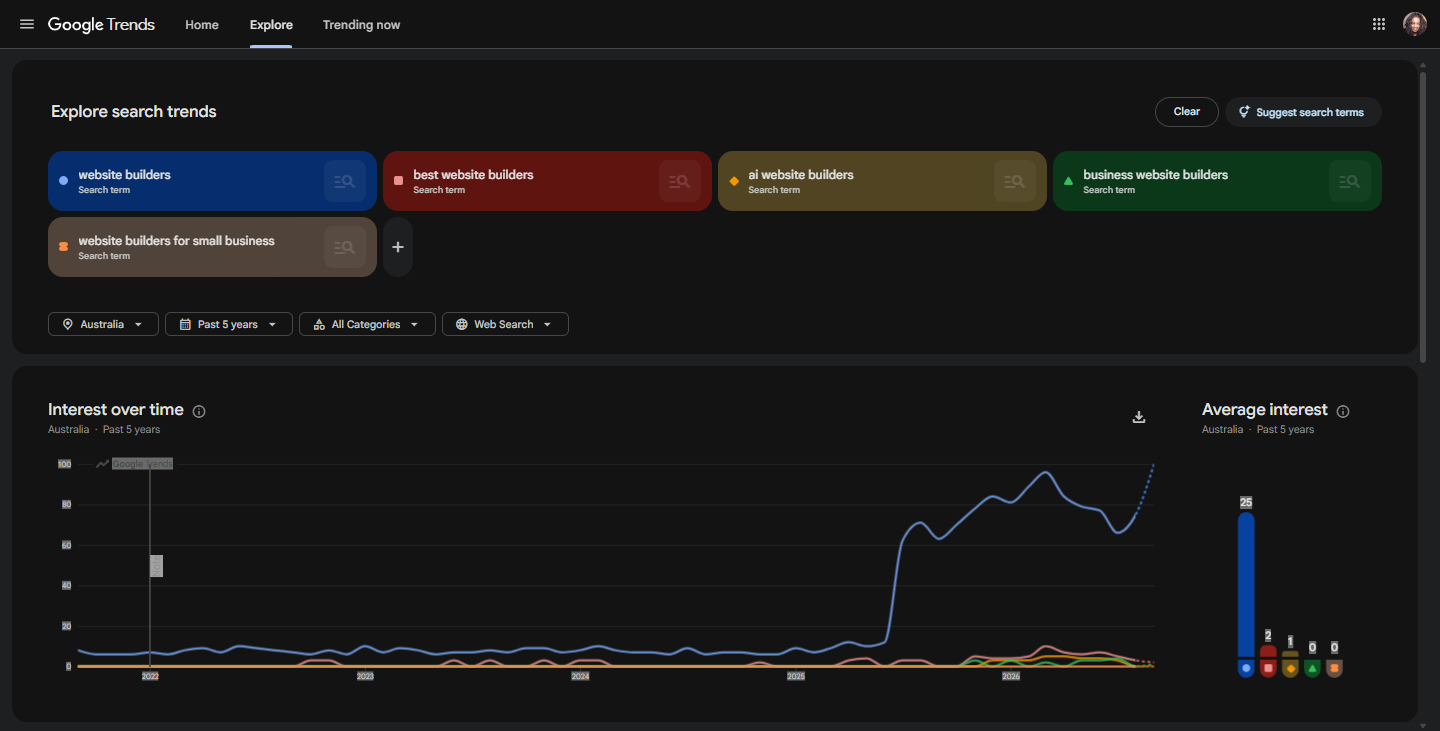
In Australia, interest across all related search terms remained minimal, with only website builders capturing enough volume to register on the five-year chart.
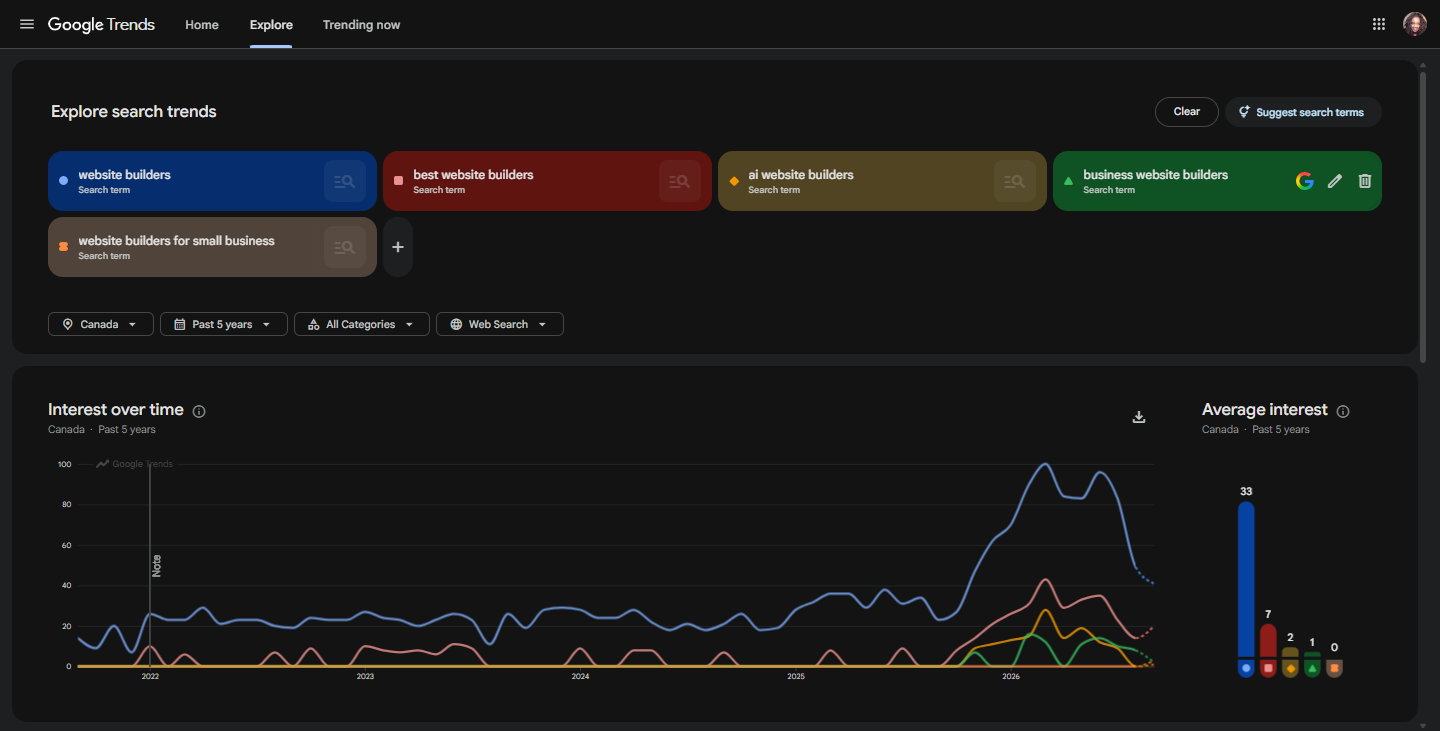
Canada is where the setting changed my read. It showed broader activity, with best website builders and ai website builders surfacing over the past year, while business website builders gained traction on the five-year view.
The read that changed the picture
The worldwide chart made website builders look like a fairly straightforward keyword to investigate. Search interest was consistent, the longer-term view showed growth, and the US and UK continued to show activity when I tested related queries.
A global view can tell you that people are searching for a subject, but it can hide how uneven that interest is across individual markets. A term can look consistent worldwide while the related searches that reveal what people actually want from that subject behave very differently by country and timeframe. If I had stopped at the worldwide chart, I could have treated the related terms as broadly applicable. Testing geography and timeframe showed that some of those ideas were much more market-specific.
Further, if a related query appears on a five-year chart but not a three-month chart, the safer conclusion is that the shorter timeframe did not provide enough data for Google Trends to register it, not that nobody searched for it.
| Term | US | UK | Canada | Australia |
| Best website builders | Registered on all windows across all time frames | Registered on all windows across all time frames | Registered in the past year and five-year mark | Registered in the five-year mark |
| Business website builders | Registered on all windows across all time frames | Registered on all windows across all time frames | Registered in the past five-year mark | Did not register across any time frame |
| Website builders for small business | Registered on all windows across all time frames | Registered on all windows across all time frames | Did not register across any time frame | Did not register across any time frame |
| Ai website builders | Registered on all windows across all time frames | Registered in the past five-year mark | Registered in the past year and five-year mark | Registered in the past five-year mark |
It’s important to note that while the timeframes suggest there was no search interest for the related search terms, it doesn’t necessarily mean zero search interest. A term registering only on the five-year chart may just reflect longer windows aggregating more data capturing enough overall volume to reach Google Trends’ threshold.
What to take from this exercise
A keyword can look strong until you change the lens. The worldwide view showed that the term website builders had steady and consistent search interest. Changing one setting at a time showed how much that view was hiding. The US and UK largely held up across the related terms, but in Canada and Australia, which terms registered depended on the time window.
What I learnt isn’t that one region outperforms another, it was that regional and timeframe filters showed where that interest was and where it wasn’t. Each change either confirms your read or breaks it, and you only find out by making it. Compare related terms, check more than one region and look at more than one time window before you act on a keyword. And while these findings can be useful, keep in mind that Google Trends only shows relative interest, not search volume or intent. Further a term that doesn’t register isn’t necessarily one nobody searches.
Start the conversation by posting the first comment