

Google researchers have developed a faster approach to query fan-out, the process that lets AI search explore several related searches from a single question. Called Retrieve-for-Train (R4T), the framework aims to make those searches more varied while reducing the time spent generating them.
Google described the research on September 15. Its tests used fashion and music datasets; deployment in Google Search remains unconfirmed. Search Engine Journal’s Roger Montti covered the announcement on September 24.
Making each branch of the search useful
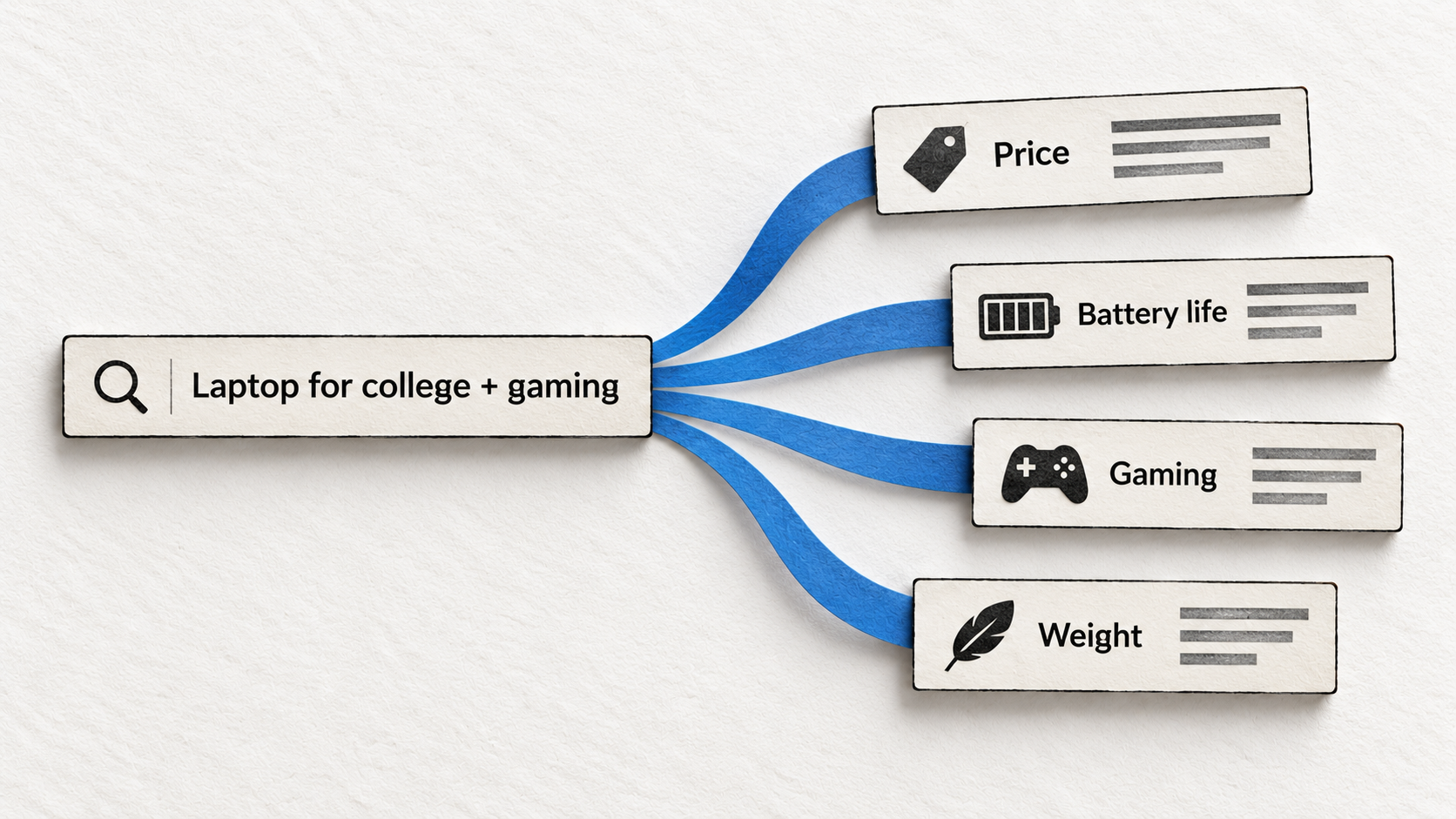
As SEW’s query fan-out explainer describes, a question about a laptop for college and gaming could involve separate searches for prices, gaming performance, weight and battery life. Each search contributes something needed for the answer.
Google’s researchers describe a problem with that process: a language model can generate several versions of essentially the same search. In its fashion example, searches about festival style become searches about festival fashion and clothes, covering similar ground.
R4T trains the model to produce a useful spread of searches that remain relevant to the request and match material in the database. The resulting examples then train a smaller diffusion model to reproduce that behaviour faster.
How R4T speeds up query fan-out
The smaller model generates retrieval directions directly as embeddings, numerical representations used to find matching items. It produces those directions together, avoiding the need to write out subqueries word by word.
In the paper’s efficiency test, systems generated 10 retrieval directions per query. For a batch of eight queries, the diffusion model took 0.07 seconds versus approximately 1.46 seconds for the autoregressive approach. For 1,024 queries, it took 4.21 seconds versus nearly 50 seconds.
Those measurements cover fan-out generation, rather than the full process of answering a question. The paper also acknowledges that some retrieval-quality assessments relied on an AI judge.
Query fan-out changes what makes a result useful
The interesting part for publishers is how this research evaluates a collection of results. A relevant result can still add little if the other results already cover the same information.
Consider the laptop example. Once a search system has enough information about price, a detailed battery test could help it answer an unresolved part of the question. Another general buying guide might contribute less. That is an illustration of how complementary sources can help answer a question, rather than a finding about which pages Google currently selects.
R4T makes that collection-level usefulness part of its training objective. Its practical appeal is the possibility of exploring distinct aspects of a request without making users wait for a language model to generate every search separately.
Start the conversation by posting the first comment