

OpenAI and Microsoft were discussing how AI products could replace visits to the publishers whose work helped train them, according to a summary-judgment brief unsealed Thursday in The New York Times copyright case.
The News Plaintiffs’ Combined Summary Judgment Brief, filed September 17 in the Southern District of New York, is a submission from The New York Times and other news organizations. It is not a court finding. The plaintiffs are asking Judge Sidney Stein to rule that OpenAI and Microsoft infringed their copyrights and that the companies’ fair-use defenses fail. OpenAI and Microsoft dispute that interpretation.
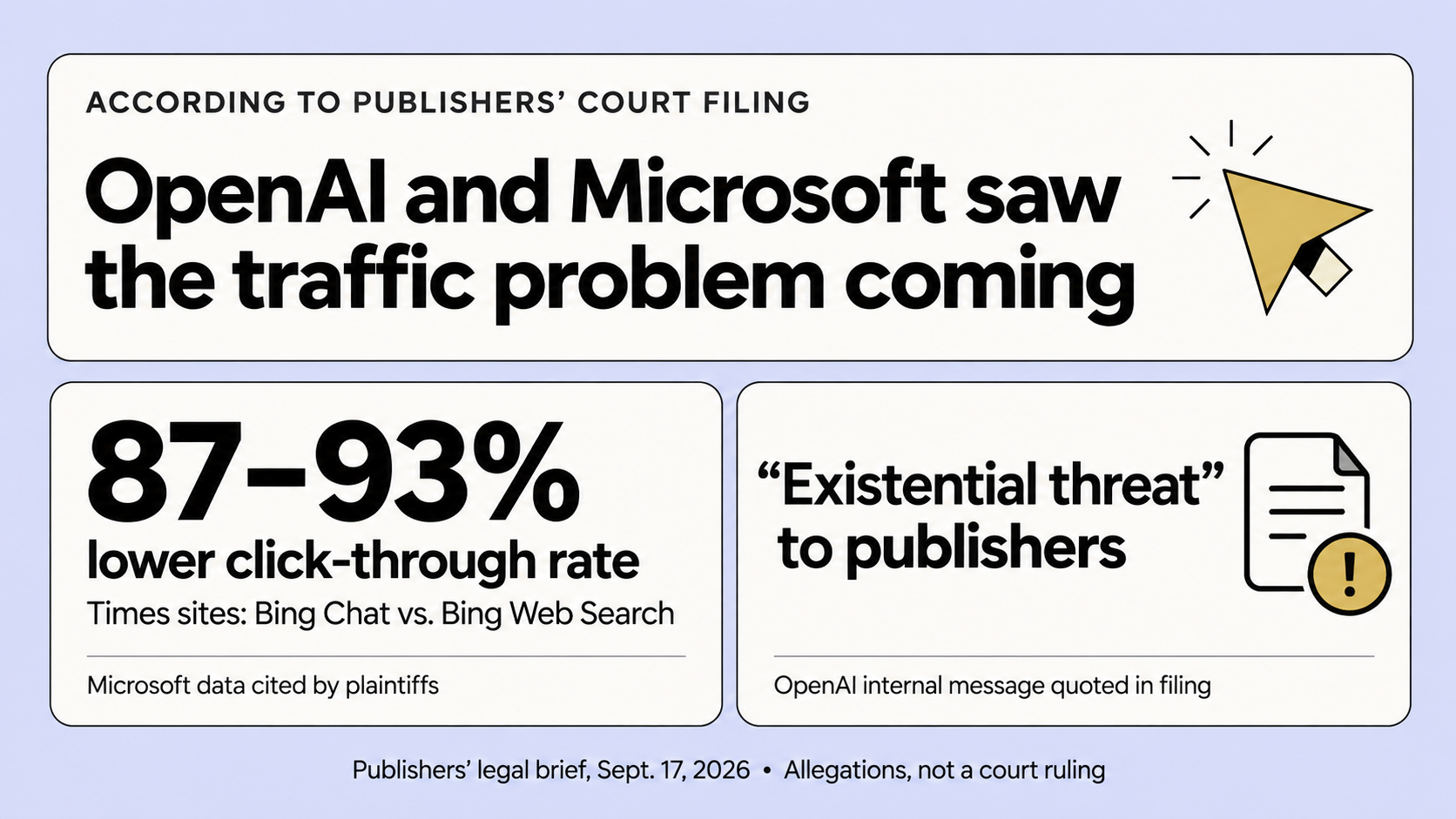
As Reuters reported, the filing quotes OpenAI’s head of ChatGPT, Nick Turley, describing publishers as facing an “existential threat” from products that were “largely substitutive” and would become more substitutive as they improved.
It also cites Microsoft Director of Applied Science Brent Hecht describing a “doom loop” in which the AI strategy could hurt both the models and the web. In another internal document cited by the plaintiffs, Hecht called large-scale AI scraping “the largest theft of labor in human history.”
Those statements are the kind of material the plaintiffs say undermines the companies’ legal position. They are not a judicial determination that the companies violated copyright.
The filing ties AI substitution to lost clicks
The brief’s most useful evidence for publishers is a traffic comparison that connects the internal discussion to a measurable outcome.
According to the filing, Microsoft’s representative data comparing Bing Chat with Bing Web Search showed overall click-through-rate reductions of 87% to 93% for Times domains, 83% to 91% for the Daily News plaintiffs’ domains, and 51% to 94% for Ziff Davis domains.
The ranges vary by publisher, and the figures come from the plaintiffs’ presentation of Microsoft’s data. They are not a market-wide benchmark. They do show the mechanism the case is about: an answer product can satisfy the query before a user visits the site that produced the underlying reporting.
The plaintiffs also cite internal material saying AI systems reduce the need to visit websites and that prominent links do not guarantee a click. OpenAI and Microsoft have argued that model training transforms copyrighted material into new content and does not compete with or replace journalism.
Microsoft told Reuters that Satya Nadella’s testimony about users getting information inside an AI platform was consistent with its legal position and described broad changes in how people find and consume information. OpenAI did not immediately respond to Reuters’ request for comment on the filing.
The brief argues that the damage extends beyond referral traffic to advertising, subscriptions, donations and the emerging market for licensing news content to AI systems. It points to publisher licensing arrangements involving several AI companies, although some financial details remain redacted.
Google is testing a price for AI answers
Google’s new AI Contribution Pilot is relevant to the publisher economics described in the filing, although it is separate from the lawsuit.
Digiday reported that Google is testing a Search Console-based program showing participating publishers a monthly payment when their content “significantly” contributes to AI-generated responses across Gemini, AI Overviews and AI Mode.
Google confirmed the program as an early-stage learning pilot, but the widget does not explain how each payment is calculated, according to Digiday.
Google’s June policy post describes a broader pilot for websites whose content contributes to the freshness and factuality of generative AI responses through grounding. It also says Google’s News AI pilot includes more than 200 publications globally.
Google’s pilot tests the revenue mechanism the filing says the market needs, but its early-stage status and opaque calculations leave the size of the exchange unresolved.
A publisher payment does not restore the lost click
Google’s pilot addresses compensation, while the filing highlights control of the audience. When an AI answer keeps the user inside the platform, a publisher may lose the chance to show ads, convert a subscription, collect a newsletter signup or build a direct relationship.
That makes the click-through data more useful than another abstract argument about whether AI output is “transformative.” It gives publishers a concrete way to evaluate what an answer engine has displaced.
The figures are limited to one company’s comparison and cannot isolate every cause of traffic change, but they put a price on the distribution shift.
SEW has also covered this product direction in OpenAI’s Sponsored Agents, where the commercial conversation begins inside ChatGPT and a website visit becomes an optional later step. For publishers, the question is whether the platform returns enough money or audience to fund the reporting that makes the answer useful.
Sources: News Plaintiffs’ Combined Summary Judgment Brief (PDF). Additional reporting: Reuters and Digiday.
Start the conversation by posting the first comment