

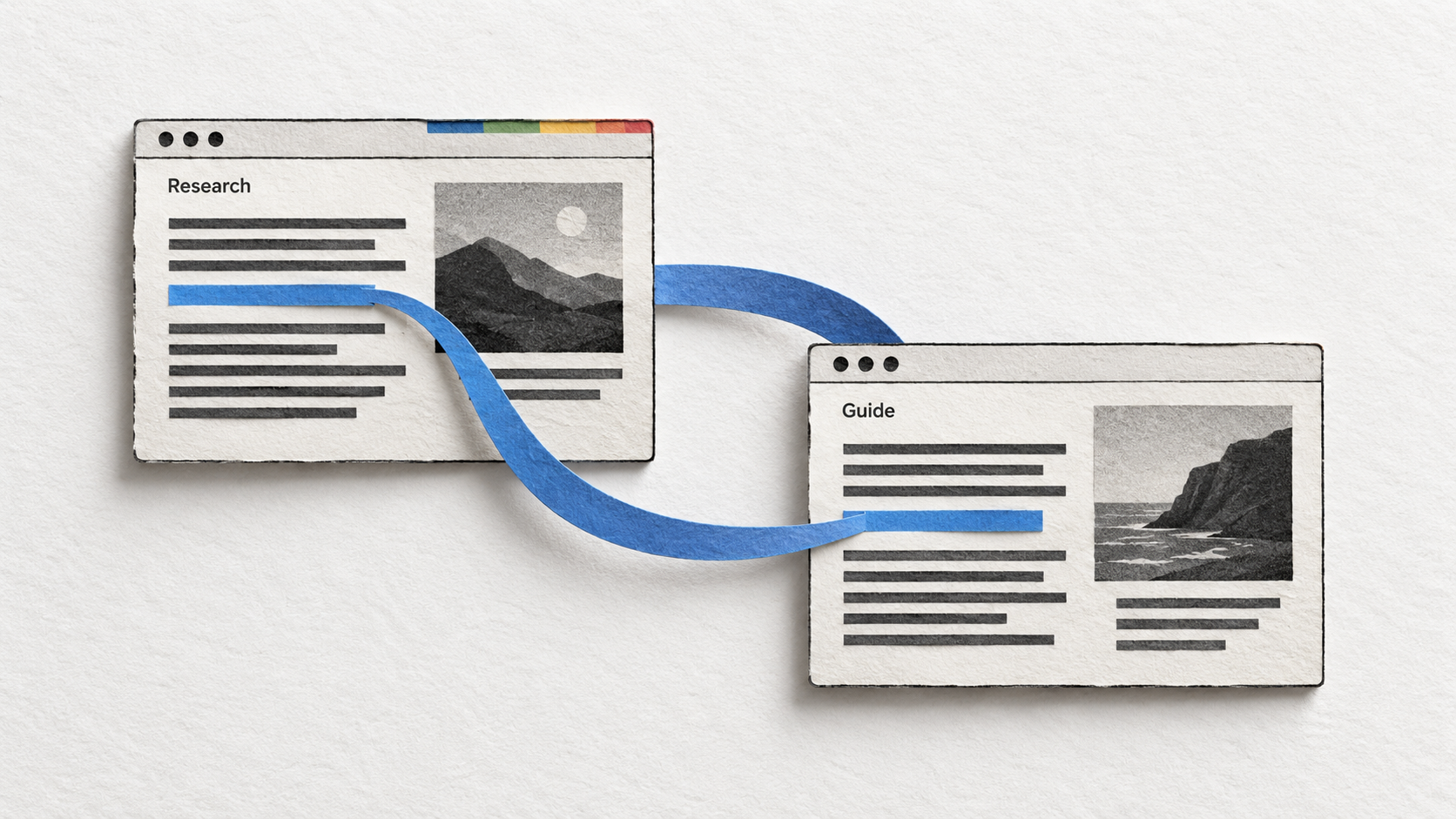
Reciprocal links happen when two websites link to each other. They aren’t automatically bad for SEO. You might cite a useful article on another site, and its editor might later recommend something you’ve published. The trouble starts when people arrange links primarily to manipulate search rankings, which falls under Google’s link-spam policy.
So you don’t need to remove a good citation just because that website links to you. You do need to look more closely at an offer that makes a backlink conditional on inserting someone else’s link.
What reciprocal links look like in practice
Imagine you run a marketing publication. You write about email campaigns and link to a software company’s research because it supports a point in your article. A few months later, that company publishes a guide and links to your explanation of newsletter sponsorships.
You now have reciprocal links. The articles cover different subjects, the links appeared at different times, and neither editor needed permission from the other. Each found something worth recommending.
The same thing can happen between businesses that work together. A hotel might link to a walking-tour company so guests can book an excursion. The tour company might recommend the hotel to visitors who need somewhere to stay. Both links give someone a useful next step.
Now imagine an agency asks you to add its client to an old article. In return, it promises a link from another website, provided you use the exact words it supplies and leave the link in place.
That offer asks you to publish a link to secure one for yourself. A backlink report may show the same two-way connection in all these examples, but it won’t show you the emails behind the arrangement.
What Google says about reciprocal links
Google lists Excessive link exchanges
and partner pages created solely for cross-linking as examples of link spam. It also flags contracts that require a link without letting the publisher qualify it, for example with nofollow. The policy focuses on links created mainly to manipulate rankings.
Google doesn’t publish a permitted percentage or monthly allowance. A small exchange isn’t automatically acceptable simply because it is small.
For a publisher considering an offer, the terms provide a useful starting point. Can you choose the source that best supports the article? Can you reject the proposed wording? Would the other party still want the placement if you qualified the link? Their answers help explain what they are trying to buy or trade.
A related website can still propose an awkward placement. An email-marketing company, for example, might have relevant research for your newsletter guide but insist that you link to its pricing page instead. Review the actual page readers will reach, rather than approving the request because the companies cover similar subjects.
Related reading: black hat SEO techniques to avoid.
What about three-way link exchanges?
In a three-way exchange, your site links to a company and a separate website supplies the promised backlink. You may never receive a link from the company you recommended.
Our assessment is that adding another website doesn’t resolve the underlying problem if the arrangement still trades links for ranking credit. It also exposes a weakness in reciprocal-link audits: a report looking only for two sites linking to each other can miss the deal entirely.
Can reciprocal links help your SEO?
A useful link can bring readers to your website, whether or not you have linked to its source. Google also uses links to discover pages and help assess their relevance. Neither point establishes that arranging a swap will improve your rankings.
An Ahrefs study, last updated in March 2020, found reciprocal links on 73.6% of 140,592 websites in its sample. The sites each had more than 10,000 estimated monthly visits from Google, and the research compared followed incoming and outgoing links.
Plenty of those sites had reciprocal links and still received search traffic. But the study didn’t test what happened when websites started swapping links. It also selected sites that already had traffic, so sites that had lost theirs could be missing from the sample. Ahrefs explicitly acknowledges that limitation.
The finding helps explain why discovering reciprocal links shouldn’t cause immediate alarm. It doesn’t establish that a link-exchange campaign works.
Why a reciprocal-link percentage can mislead you
Before worrying about a percentage in a backlink report, check what it counts. The same website can have a reciprocal-link ratio of 30% or 2%, depending on the calculation.
Take this made-up example: your site links to 40 other domains, receives links from 600 domains, and has 12 domains in both groups.
| What you’re measuring | Calculation | Result |
|---|---|---|
| Of the domains you link to, how many link back? | 12 ÷ 40 | 30% |
| Of the domains linking to you, how many receive a link back? | 12 ÷ 600 | 2% |
Both numbers are correct. Neither tells you whether the links were independently chosen or negotiated.
Counts of individual links introduce another difference. A link repeated in a website’s footer can appear on hundreds of pages while representing a connection with just one domain. Before comparing your number with someone else’s, establish whether both reports count links, pages or domains and use the same calculation.
These percentages can help you find relationships to investigate. They can’t give you a safe quota for future swaps.
A link can stop helping without a manual penalty
Google explained in its December 2022 link-spam update that its SpamBrain system could neutralize unnatural links, removing the ranking credit they had passed. That gives you another possible outcome to consider: time spent arranging links that no longer provide the benefit you expected.
A manual action is a separate matter. It follows a human review, and Google reports it in Search Console’s Manual actions report. An empty report doesn’t prove your exchanged links are helping. Equally, a fall in traffic doesn’t prove reciprocal links caused it.
How to check the reciprocal links you already have
If you are reviewing a handful of known exchanges, start with the pages and the original emails. Those emails may tell you exactly why a link was added, including whether someone promised a return placement or specified the wording.
To find incoming examples for free, open Google Search Console’s Links report. Under External links, select More beneath Top linking sites. Choose a domain, then one of your linked pages, to investigate the pages linking to it.
Google’s documentation explains that this is a sample, not a complete backlink list. It can include links that have since disappeared and doesn’t identify nofollow links. A link missing from Search Console may simply be missing from its sample.
Find your links to those websites separately, using your CMS or an existing crawl. Then open both pages and read the paragraphs containing the links. Check where they lead, what the clickable words say, and whether the destinations still support the surrounding text.
Keep a useful citation if it still belongs in the article. If a link was inserted purely to complete a swap, revisit that placement. A spreadsheet of domains alone won’t tell you which sentence needs changing.
For a large website, a crawler can help locate outgoing links across thousands of pages. A separate backlink index may find incoming links that Search Console’s sample misses. Those tools can save time finding the pages; you still need to examine what was published and any agreement behind it.
When to use nofollow or sponsored
You don’t need to add nofollow to an ordinary editorial link just because the destination links back to you. Google’s outbound-link guidance says regular links need no special rel attribute.
For advertising and paid placements, Google prefers rel="sponsored", although it also accepts nofollow. For other cases where you don’t want Google to associate your site with the destination, nofollow may be appropriate. Apply the attribute to the actual relationship.
If you are cleaning up manipulative outgoing links, Google’s manual-action guidance calls for removing them or changing them so they no longer pass ranking credit. Changing a link on your own site doesn’t change the backlink on somebody else’s.
Should you disavow reciprocal links?
Finding a reciprocal link is not, by itself, a reason to disavow it. Google says most sites don’t need the disavow tool. Its criteria are considerably narrower: a substantial number of spammy, artificial or low-quality incoming links, together with a manual action or a likelihood of one.
Where those conditions apply, Google recommends trying to get the problematic links removed first. Disavowing is for incoming links you can’t remove. It won’t fix an outgoing link that you control.
SEW’s take: keep the decision with the editor
For publishers, a useful test is what happens when the proposed link doesn’t survive editing. Can you leave it out, replace it with a better source, or change the wording without owing someone another backlink?
If you’ve promised to publish the link regardless, you’ve given away that decision. A relevant domain or an impressive backlink score won’t make the sentence any more useful to the reader.
You can still invite people to send research, tools or explanations worth citing. A reply to an exchange request could be as simple as:
Send the resource and tell us which part of the article it supports. We’ll consider it on that basis. You don’t need to link to us.
Start the conversation by posting the first comment