

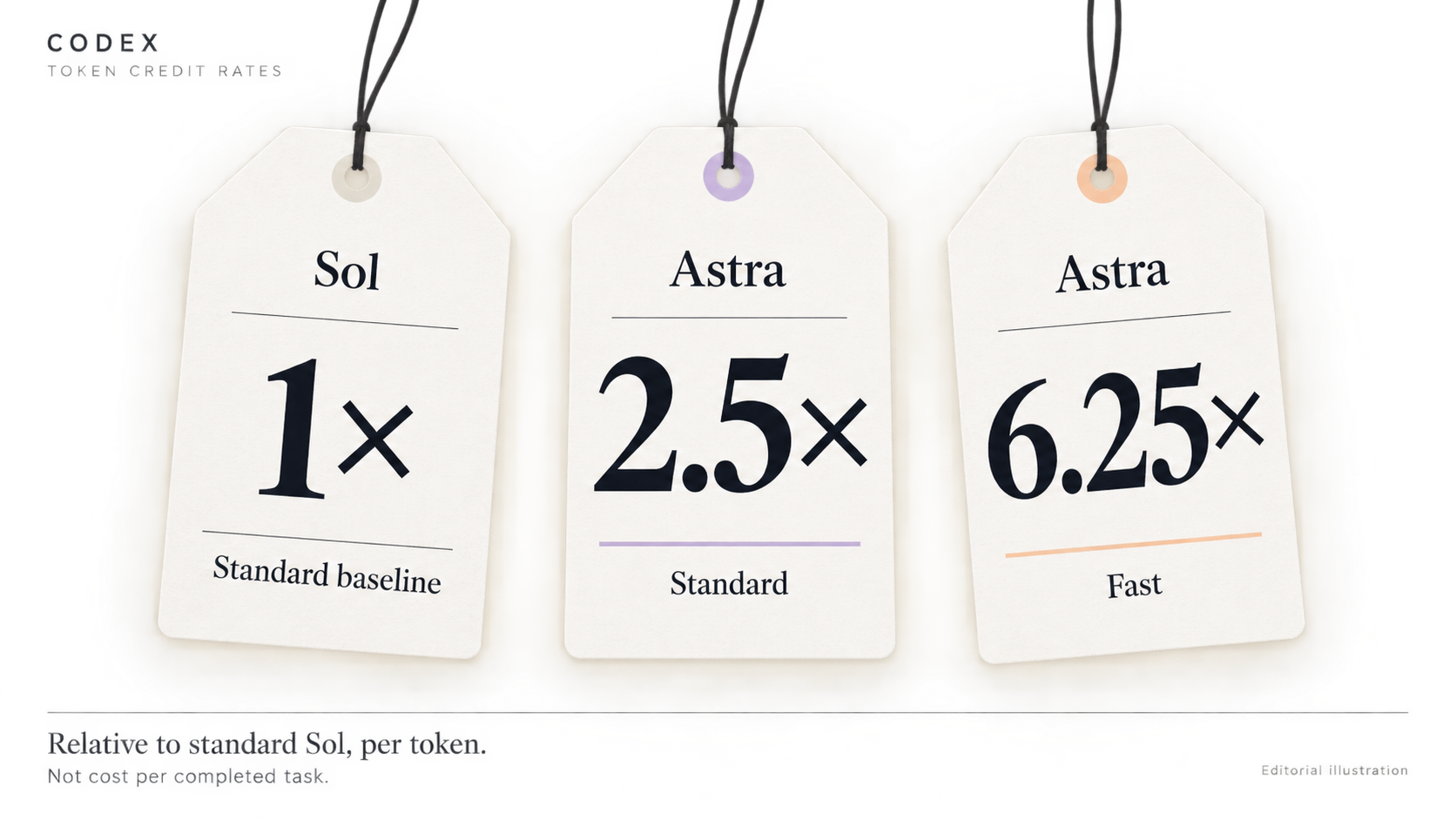
Some Codex subscribers are urging each other to avoid GPT-6 Astra after reporting that the model exhausts their paid usage allowances too quickly. A discussion in r/codex tells users to stick with GPT-5.6 Sol when their limits reset, with replies describing depleted subscriptions and a return to Claude.
“We are sick of paying 200$ to use it for a day,” wrote the post’s author, DivideHorror3217. In a reply, they said they were paying for two $200 subscriptions, both with 1% remaining. The discussion contains no usage logs establishing how much work those accounts performed.
Experiences in the same thread differ. One commenter reported completing three Astra projects using 9% of their weekly allowance. Another said a single five-hour Sol task had consumed half their allowance. Those accounts show the frustration around usage, but they are not comparable tests of the two models.
Astra’s higher rates explain part of the complaint
OpenAI’s published credit rates show the difference:
| Model | Input | Cached input | Output |
|---|---|---|---|
| GPT-5.6 Sol | 100 | 10 | 500 |
| GPT-6 Astra | 250 | 25 | 1,250 |
Credits per million tokens, checked September 19, 2026. Sol’s listed rates are promotional.
Astra’s Fast mode adds a further 2.5-times multiplier. Multiplying the two gives a rate 6.25 times standard Sol’s for the same token volumes. These ratios compare token rates, not completed-task costs.
OpenAI says allowance consumption also depends on context, tools and task complexity. Local and cloud work share the plan’s allowance, and weekly limits can apply. Its model guidance separately notes that higher reasoning settings use more tokens. The Reddit post’s recommendation to use Sol at “xhigh” therefore does not establish which setting gets the most work done per allowance.
OpenAI has confirmed incorrect rate limiting before
There is a documented precedent for account-specific usage complaints. In a June incident report, OpenAI said its abuse and fraud prevention systems were incorrectly rate limiting certain accounts, contributing to reports that Codex allowances were depleting faster than expected.
The company described the impact as limited and said it had not observed broader degradation in Codex usage. The incident was marked resolved on June 29. That history gives users a concrete reason to question unexpected consumption, but it does not establish that the same fault has returned.
The Reddit author goes further, alleging that OpenAI has deliberately weakened Sol for some users to push them toward Astra. The thread supplies no evidence establishing selective degradation or that motive. The earlier incident concerned rate limiting and supplies no evidence of intentional changes to Sol’s answers.
Astra has to earn back its higher token cost
If both models deliver an acceptable result with the same input, cached-input and output proportions, standard Astra must use 60% fewer billed tokens to match Sol’s token cost. Halving token consumption would still cost 25% more. This is rate-card arithmetic, not a performance test.
Astra could still save money if it solves a problem Sol cannot or substantially reduces human correction. For an agency paying staff to repair generated code, that labour could outweigh the token premium. For repeated tasks that Sol already completes correctly, the higher rate leaves less room within a fixed budget.
Start the conversation by posting the first comment