

A site can pass every check in a classic SEO audit and still be missing from AI answers. The pages load fast, the titles are clean and Google indexes everything. Yet when a buyer asks ChatGPT or Perplexity for the best option in that category, the brand does not come up, or it comes up with an old price and a feature it dropped two years ago.
Writesonic reports that 60% of sites block AI crawlers without knowing it, and blocked access is only one of several hidden causes. An AI SEO audit, also called a GEO (generative engine optimization) audit, is the process of finding them.
What does an AI SEO audit cover?
A full-scale search engine optimization audit for AI search should evaluate:
- AI crawler access: Robots.txt, firewall and CDN rules that let AI bots in or keep them out.
- Server responses to AI bots: 404, 403 and 500 errors served to AI crawlers but not to people.
- Rendering: Main page text that sits in the raw HTML versus text that only appears after JavaScript runs.
- Content structure: Plain headings, short answer paragraphs, tables, FAQs and lists that AI systems can quote.
- Structured data: Schema markup for products, organizations, articles, FAQs and reviews.
- llms.txt and sitemaps: A clean map of the main pages for AI systems.
- Brand visibility in AI answers: How often the brand appears for the prompts buyers actually ask.
- Citations: Which pages and third-party sites AI engines cite for the brand and for competitors.
- Accuracy and sentiment: How correctly AI answers describe products, prices and features, and in what tone.
- Share of voice: How brand mentions compare with competitors across AI engines.
- AI referral traffic: Visits and conversions that come from ChatGPT, Perplexity, Gemini and similar platforms.
SEO audit vs AI SEO audit: differences
| Area | Classic SEO audit | AI SEO or GEO audit |
| Main question | Can Google crawl, index and rank the page? | Can AI engines reach, understand and cite the page and the brand? |
| Crawlers checked | Googlebot and Bingbot | GPTBot, ClaudeBot, PerplexityBot, Google-Extended and other AI agents |
| Unit of measurement | A keyword and its position | A prompt and if the brand appears in the answer |
| JavaScript | Google renders it, so client-side content often still ranks | Many AI crawlers skip it, so client-side content can be invisible |
| Off-site focus | Backlinks and domain authority | Brand mentions on review sites, forums, Wikipedia and news |
| Result stability | Positions move slowly and predictably | The same prompt can return a different answer from one run to the next |
| Typical fixes | Titles, links, speed, indexation | Bot access, server-side text, answer-style content, mentions on trusted sites |
Both audits still matter. AI engines often pull from pages that already rank well in search, so a weak technical SEO base usually means weak AI visibility as well.
AI SEO audit tools: what they find and how they fix website and brand issues
| Tool | Type | AI engines covered |
| Semrush AI Visibility Toolkit | Tracking plus site audit | ChatGPT and Google AI Mode |
| Ahrefs Brand Radar | Mention and citation research | 6 indexes, including ChatGPT, Perplexity, Gemini and Copilot |
| Profound | Enterprise tracking plus crawler analytics | Up to 9 |
| Peec AI | Daily tracking | 3 per plan, more as add-ons |
| Scrunch | AI site audit plus tracking | 9, including Claude, Meta AI and Grok |
| OtterlyAI | Tracking plus page-level GEO audit | 4, plus 3 add-ons |
| AthenaHQ | Tracking plus content actions | Up to 11 |
| Goodie | Tracking plus done-for-you actions | 7 |
| Writesonic GEO | Audit and fix workflow | Several, by plan |
| HubSpot AI Search Grader | Free one-time brand check | 3: OpenAI, Perplexity and Gemini |
1. Semrush AI Visibility Toolkit
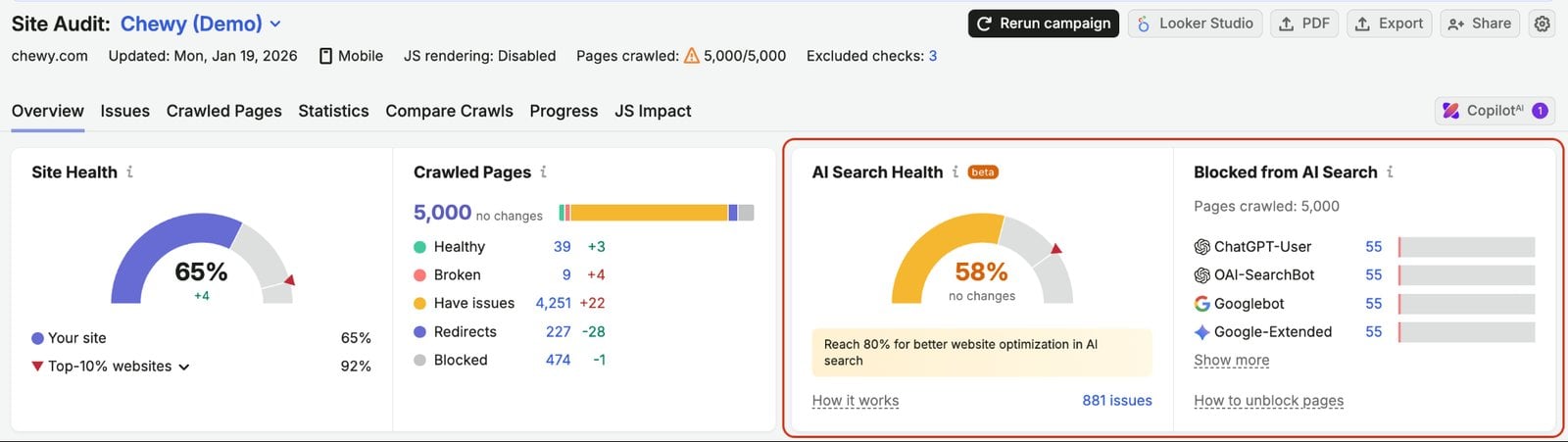
The Semrush AI Visibility Toolkit shows how your brand appears in AI search. You can see your total visibility and share of voice across AI platforms, and spot the prompts, mentions and sources where rivals appear but you do not. The toolkit tracks positive and negative sentiment in your brand mentions, shows how each AI platform perceives your brand and gives steps to make your content easier for AI to understand and cite.
Top features:
- AI Search Health score: Shown next to the classic Site Health score, with 80% set as the target.
- Blocked from AI Search widget: Counts blocked pages separately for ChatGPT-User, OAI-SearchBot, Googlebot and Google-Extended, since one bot can be blocked while others get through.
- JS Impact tab: Compares each page with and without JavaScript rendering.
- Prompt Research and Prompt Tracking: Lists the questions people ask in a topic and tracks chosen prompts in ChatGPT and Google AI Mode across more than 220 countries and territories.
AI SEO issues it finds:
- Pages closed to OpenAI bots: Usually caused by an old robots.txt rule or a CDN bot setting that still lets Googlebot in.
- Text that only exists after rendering: Content and internal links that AI crawlers reading raw HTML never see.
- Score drops between crawls: A fall in AI Search Health that points to a recent site release or plugin change.
AI SEO issues it fixes:
- Blocked crawlers: Each blocked page links to the exact robots.txt or firewall change needed to let the bot in.
- Audit errors: Every check explains why it matters and how to fix it, which helps teams without a technical SEO.
- Content gaps on rival prompts: Prompt Research shows the questions where rivals appear, so the team knows which pages to write or expand.
Pros:
- One account for SEO and AI work: A drop in AI presence can be traced to a site change without exporting data.
- Easy reporting: Managers and clients understand a single percentage.
- Prompts based on demand: Tracked prompts come from search interest data, not guesswork.
- Daily tracking with recommendations: Priority prompts are tracked daily, with growth suggestions for each.
Cons:
- Tight prompt allowance: The base plan is small for a brand with several product lines.
- No trial: Teams pay before testing the toolkit on their own site.
- Two tracked engines: Prompt Tracking skips Perplexity, Gemini and Claude.
Pricing: $99 per month for one project, one domain, 25 tracked prompts and AI Search Checks on up to 100 pages. Extra prompts cost more.
2. Ahrefs Brand Radar
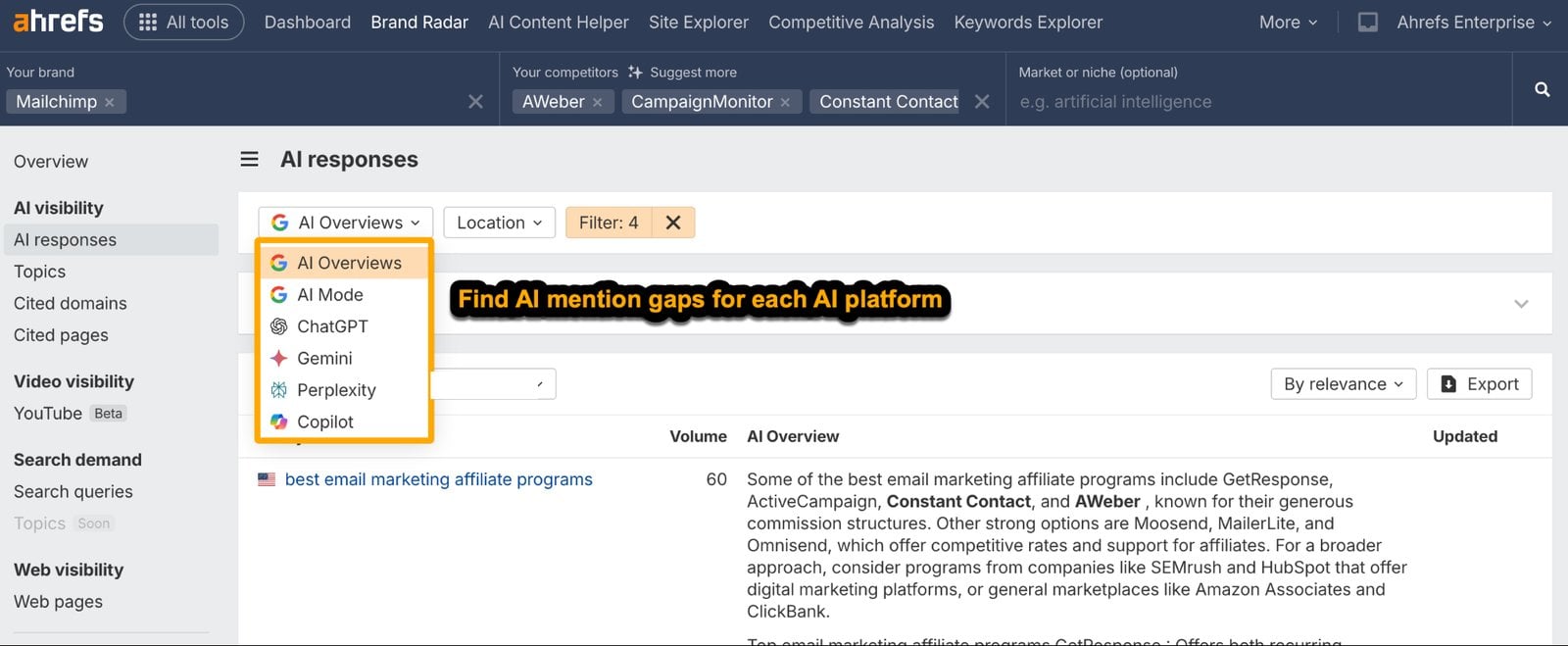
Ahrefs Brand Radar tracks how your brand shows up in AI answers. You can track the exact questions your buyers ask, look up the AI visibility of any brand without setup and benchmark your brand against competitors. It also monitors brand sentiment, shows at which buying stage your brand appears and shows which pages AI sends traffic and crawlers to.
Top features:
- AI Mentions, AI Citations and AI Share of Voice: The three core metrics, split by AI index.
- Mention gap report: Lists prompts where competitors are named and the brand is not.
- Cited pages report: Shows the exact URLs AI answers quote for the brand and each rival.
- YouTube, TikTok and Reddit research: Searches the videos and threads that influence AI answers about your category.
AI SEO issues it finds:
- Topic gaps: Subjects where rivals are recommended and the brand never comes up.
- Uncited pages: Product, comparison or guide pages that rank in Google yet never appear in AI answers.
- Weak community presence: Few or no brand mentions in the Reddit threads and videos AI engines quote.
AI SEO issues it fixes:
- Missing mentions on cited sites: The cited pages list doubles as an outreach list of articles, reviews and threads.
- Missing page types: Pages cited for rivals show which formats, such as comparisons or guides, the brand still needs.
- Technical crawl problems: Ahrefs Site Audit adds a fix note to each crawl and HTML issue.
Pros:
- Market-wide sample: The prompt database is far larger than any hand-picked list.
- Six AI indexes in one report: Coverage runs from ChatGPT to Copilot.
- URL-level detail: PR and content teams get specific targets, not general advice.
- Connected data: Backlink and keyword data sit in the same account.
Cons:
- Cost adds up fast: Each AI index is billed on top of a paid Ahrefs plan.
- Missing engines: There is no Claude or Grok index yet.
- Two tools for one audit: AI visibility and page-level checks sit in separate products.
Pricing: Brand Radar is an add-on to a paid Ahrefs plan, which starts at $129 per month. Each AI index costs $199 per month, or $699 per month for all six.
3. Profound
Profound is an AI marketing platform that helps your brand win in ChatGPT and other AI search platforms. Its AI Marketer finds the work worth doing, drafts it and asks you for approval before anything goes live. You can also analyze what people ask AI, track your visibility score by platform and see how answer engines describe your category.
Top features:
- Agent Analytics: Shows which pages each AI bot fetches and how often it returns.
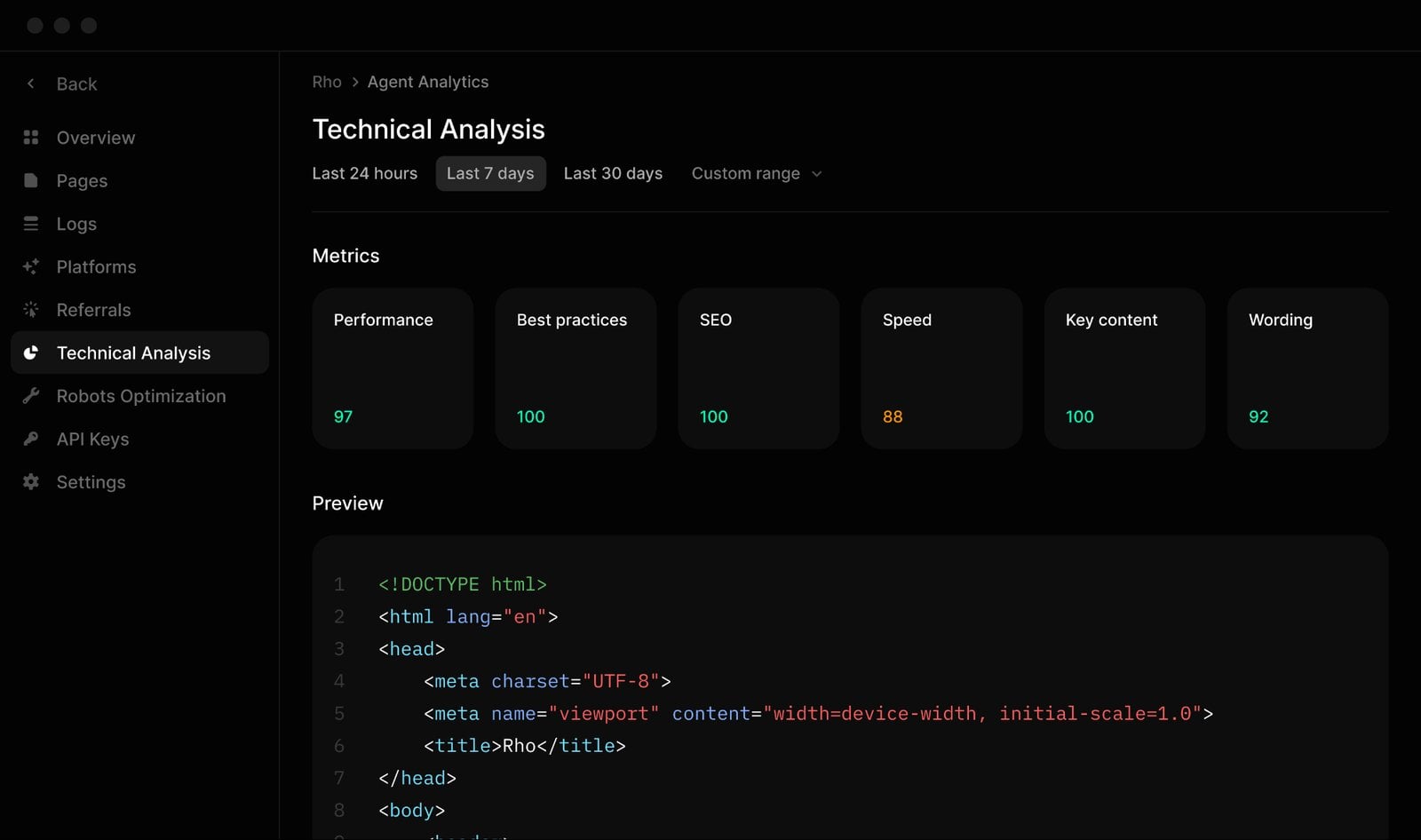
- Technical Analysis scores: Rates performance, best practices, SEO, speed, Key content and Wording, with low scores flagged in color.
- Bot-view preview: Displays the raw HTML an AI crawler receives.
- Prompt Volumes: Estimates how often people ask a question in AI tools.
AI SEO issues it finds:
- Ignored pages: Important URLs no AI crawler has fetched in weeks, often buried deep or missing from sitemaps.
- Missing text in the bot version: Headings and paragraphs people see that never reach the crawler.
- Fake crawler traffic: Requests that claim to be AI bots but come from other IP ranges.
AI SEO issues it fixes:
- Hidden content: The AI Marketer opens up content AI crawlers cannot read, and the bot-view preview confirms the change.
- Crawler access: Robots Optimization settings set which AI bots get in.
- Fading citations: Pages losing AI citations are rewritten and staged as drafts in the CMS for review.
Pros:
- Real bot behavior: Logs beat a simulated crawl for accuracy.
- Broad engine list: Enterprise plans include Claude and DeepSeek.
- Smarter prompt picks: Tracking budget goes to questions with real demand.
- Before-and-after checks: Crawler activity can be compared across site releases.
Cons:
- No public brand pricing: Budgets need a sales call.
- Engineering setup: Marketing teams cannot install the server tracker alone.
- Too big for small sites: Depth and price make more sense for large brands than for a local business.
Pricing: A 7-day free trial covers three engines with a fixed prompt set. Enterprise brand plans are custom. Agency Growth costs $99 per month plus $399 per month for each client workspace.
4. Peec AI
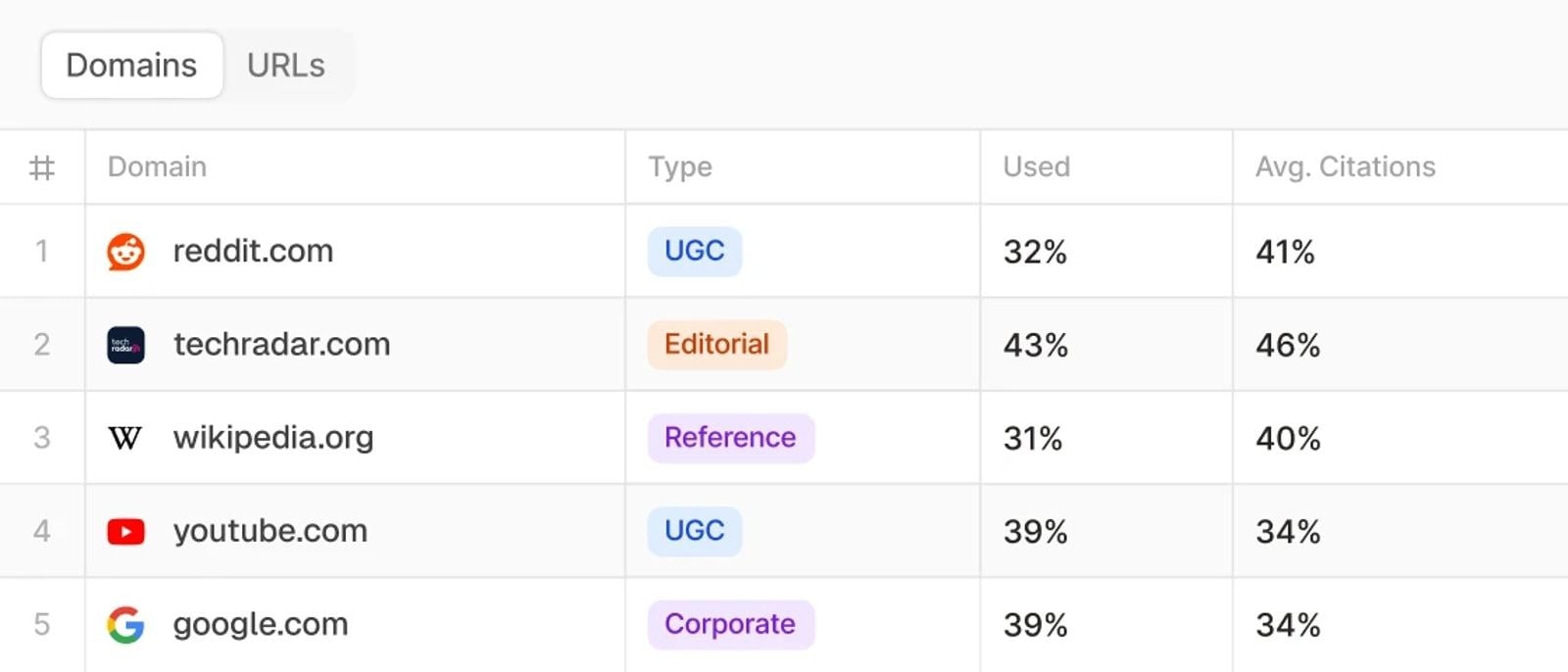
Peec AI lets you track, analyze and improve how your brand performs on AI search platforms. You can find and organize the prompts that matter, use AI-suggested prompts with search volumes and act on what the data shows before competitors do.
Top features:
- Source audit by type: Sorts every cited domain as UGC, editorial, reference or corporate, with how often each is used and cited.
- Position tracking: Records if the brand is listed first, in the middle or last.
- Sentiment scores: Rates the tone of each answer about the brand.
- Daily runs: Repeats every prompt daily to smooth out random swings.
AI SEO issues it finds:
- Forum-led categories: Topics where Reddit and other forums supply most of the answer, which calls for community work instead of new pages.
- Late placement: Prompts where the brand appears but sits at the end of a list.
- Negative tone: Answers that describe the brand poorly or repeat old complaints.
AI SEO issues it fixes:
- Low placement: The sources behind each answer show which brand pages to update first.
- Wrong or negative descriptions: Flagged claims get corrected on the site and on outside profiles.
- Rival-friendly sources: The source list becomes a pitch list of publishers and review sites.
Pros:
- Affordable daily data: Far cheaper than enterprise platforms.
- Client-friendly reports: Three metrics that need no training to read.
- Unlimited seats: Useful for agencies with large teams.
- Custom dashboards: API access and a Looker Studio connection on higher plans.
Cons:
- No technical audit: Robots.txt, rendering and page structure need a second tool.
- Limited models per plan: Extra AI engines raise the monthly bill.
Pricing: Starter $95 per month for 50 prompts, Pro $245 per month for 150 prompts and Advanced $495 per month for 350 prompts. Enterprise is priced on request.
5. Scrunch
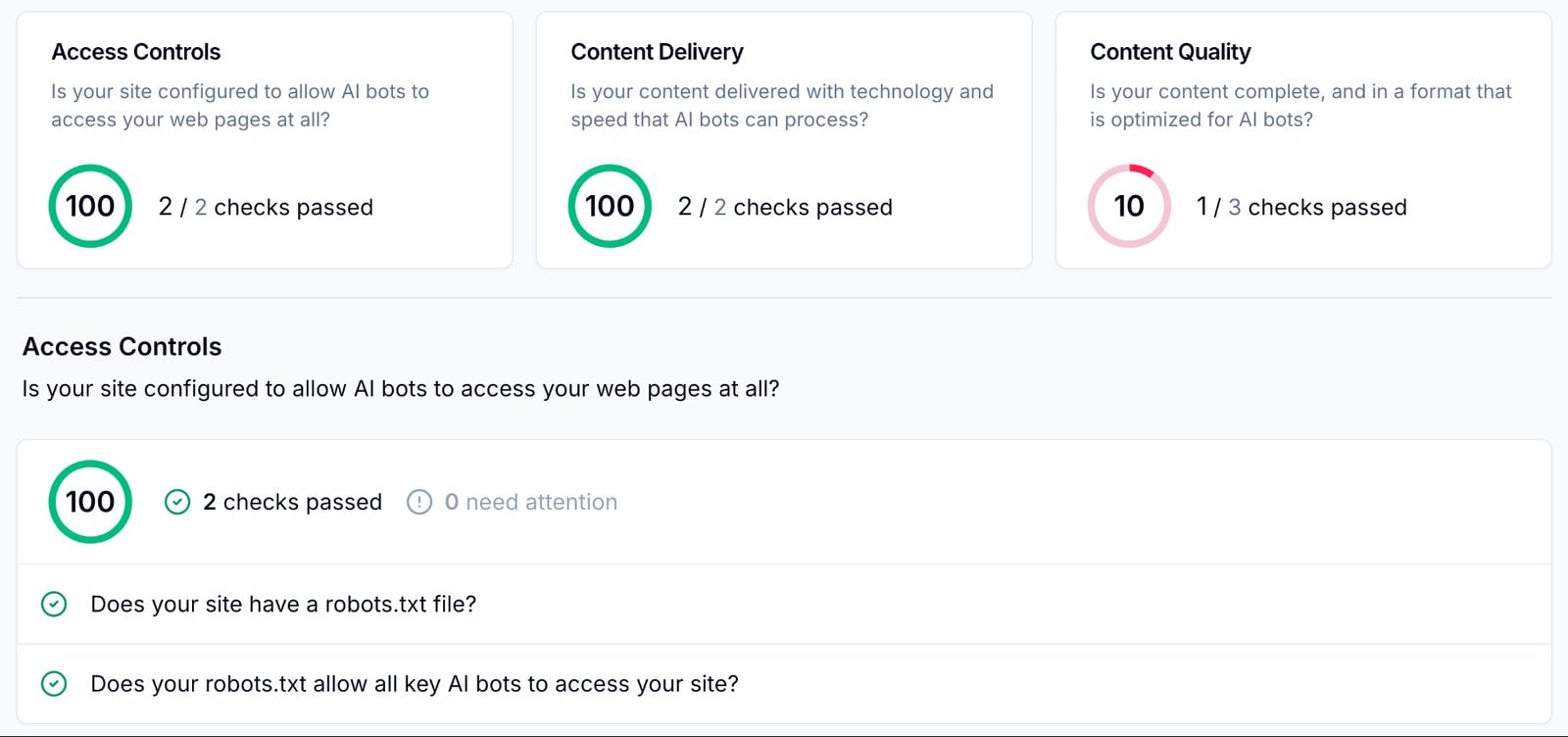
Scrunch gets your site ready for AI so you show up in answers and get cited. You can monitor prompt results, discover the sites that shape AI answers and see what AI agents say and do, both on AI platforms and on your own site. Its Agent Experience Platform (AXP) then optimizes your web presence for agents without changing the experience for people.
Top features:
- Access Controls score: Checks for a robots.txt file and if it lets the main AI bots in.
- Content Delivery score: Checks if the page is served with technology and speed AI bots can process.
- Content Quality score: Checks if the content is complete and in a format AI systems can use.
- Change alerts: Detects shifts in AI answers, explains why they matter and suggests what to do.
AI SEO issues it finds:
- Robots.txt problems: A missing file or rules that block AI bots.
- Slow or script-heavy delivery: Pages built with client-side rendering that bots struggle to process.
- Thin content: Pages without enough complete text to answer a full question.
- Messy markup: HTML too fragmented for bots to split into clean sections.
AI SEO issues it fixes:
- Content hidden from bots: AXP serves AI agents a structured copy of the page while people see the normal design.
- Unclear priorities: Pages with the lowest scores rise to the top of the work list.
- Weak answers for target buyers: Persona-based prompt results show which buyer questions are still unanswered.
Pros:
- Exact URLs: Every problem points to a specific page.
- Wide AI coverage: Tracks nine platforms, including Claude, Meta AI and Grok.
- Buyer personas: B2B and B2C prompts can be measured separately.
- Free trial: Seven days to test the audit on a live site.
Cons:
- AXP not widely available: It was limited to selected customers at the time of writing.
- Higher entry price: Costs more than tracking-only tools.
Pricing: From $300 per month for 350 custom prompts and three personas, with a 7-day free trial.
6. OtterlyAI
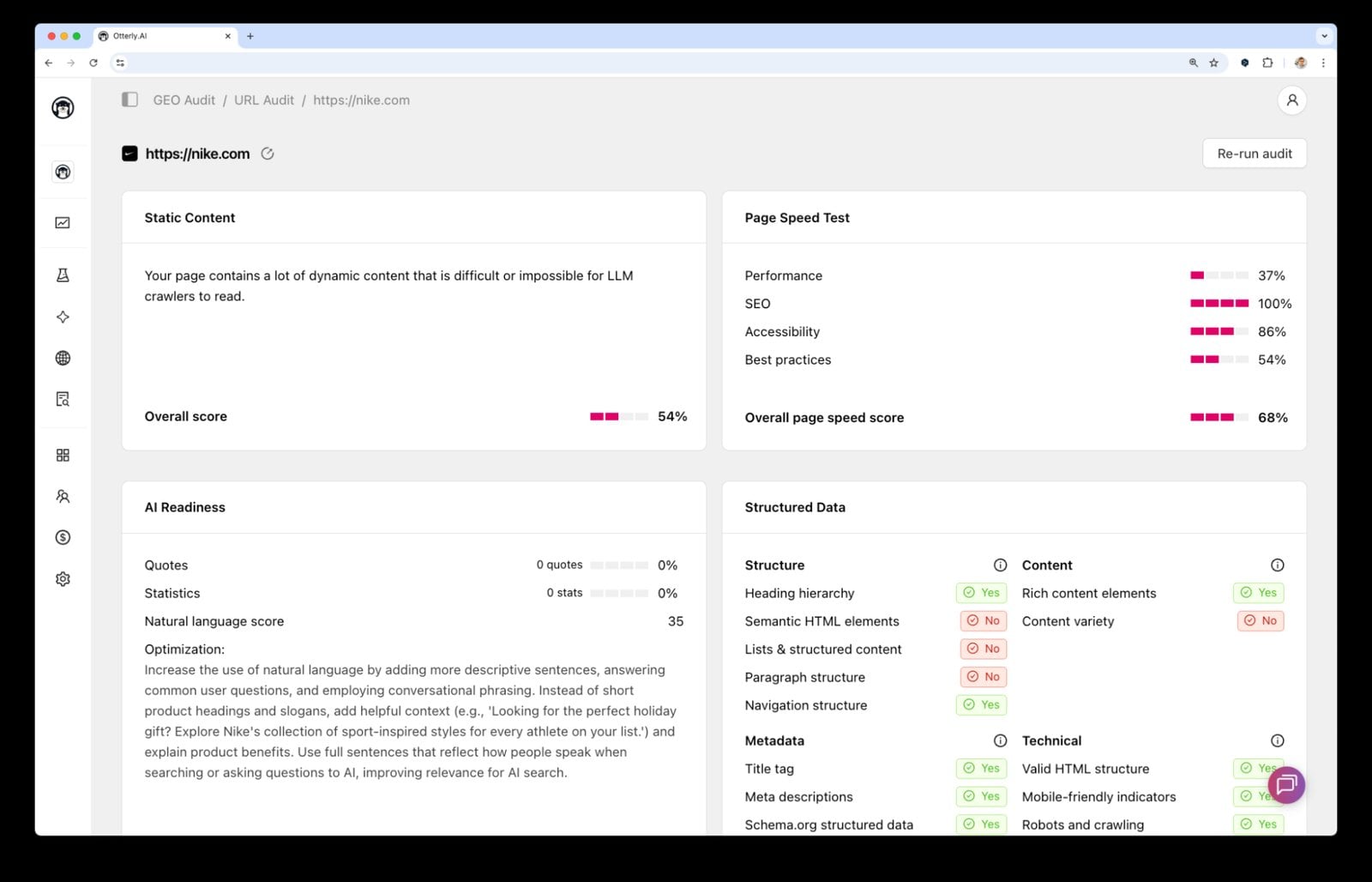
OtterlyAI shows how AI search engines mention and cite your brand across ChatGPT, Google AI Overviews, Google AI Mode, Perplexity, Gemini, Copilot and Claude. You can uncover the prompts, topics and intent patterns behind AI answers in your category and see where your brand and website appear or drop out. Its crawlability checks, content audit and content briefs show why AI skips a page and how to fix it, and its recommendations help turn your pages into sources that AI engines cite.
Top features:
- Static Content check: Measures how much of the page is plain HTML that LLM crawlers can read.
- AI Readiness report: Counts quotes and statistics and gives a natural language score.
- Structured Data checklist: Marks heading hierarchy, semantic HTML, lists, metadata and schema as Yes or No.
- Page Speed Test: Scores performance, SEO, accessibility and best practices in the same report.
AI SEO issues it finds:
- Nothing to quote: Pages with no quotes or statistics for an AI engine to cite.
- Missing semantic markup: Pages without semantic HTML or list markup.
- Slogan-style copy: Taglines and short headings in place of sentences that explain the product.
AI SEO issues it fixes:
- Slogan-style pages: The advice includes example sentences, such as fuller product descriptions AI can quote.
- Missing sub-questions: Query Fan-Out lists the hidden follow-up questions AI engines create from one prompt, ready to become new sections or FAQs.
- Blocked bots: The Crawlability Checker names the server or robots.txt rule behind each block.
Pros:
- Lowest entry price: The cheapest paid plan in this list.
- Client-ready PDFs: Agencies can send audits as they are.
- Simple pass mark: The readiness target is easy to explain to a client.
- Developer access: Higher plans add API, MCP and Agent Analytics.
Cons:
- One URL at a time: Bulk audits need the API.
- Paid engine add-ons: Gemini, Claude and Google AI Mode cost extra.
Pricing: Lite $25 per month for 15 prompts, Standard $160 per month for 100 prompts and Premium $422 per month for 400 prompts. Enterprise is custom.
7. AthenaHQ
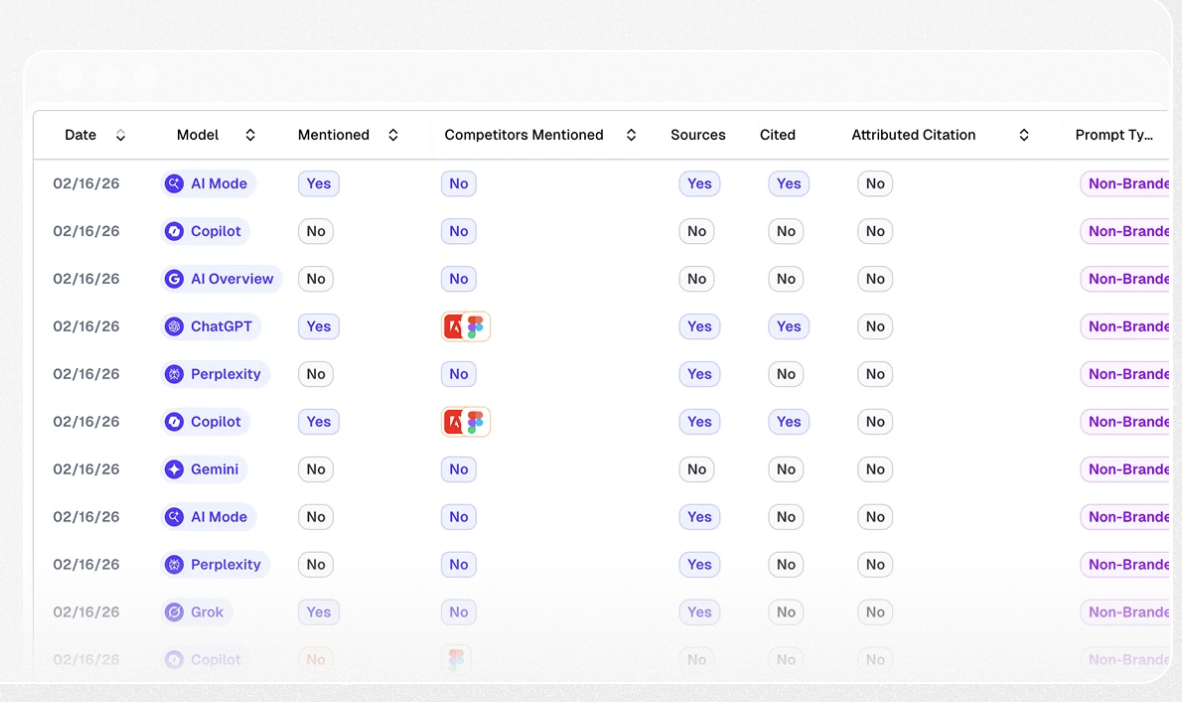
AthenaHQ helps you see, act on and improve how your brand appears in AI search from one command center. It tracks your visibility across more than 11 AI models and gives automated content optimization recommendations.
Top features:
- Content gap detection: Compares each tracked page with the questions AI engines are asked.
- Knowledge base and claim review: Stores approved prices, features and policies, then flags AI answers that contradict them.
- Source tracking: Shows which sites AI engines rely on for each prompt.
- Credit-based tracking: One credit equals one AI response, spread across any mix of prompts, rivals and engines.
AI SEO issues it finds:
- Unanswered buyer questions: Pages that skip what people ask AI tools about the product.
- Wrong facts in AI answers: Old prices, dropped features or outdated policies.
- Thin product pages: Too little detail for an AI engine to recommend the product.
AI SEO issues it fixes:
- Content gaps: Its content agent writes an AI-optimized version of the page.
- Crawler access: robots.txt and llms.txt rules can be changed from inside the tool.
- Slow publishing: Edits go live on Shopify and Webflow without a developer.
Pros:
- Free plan: Enough credits to test the audit on a few prompts.
- Unlimited users: Whole teams share one account.
- Flexible spending: More credits during a launch, fewer in quiet months.
- Wide model coverage: Up to 11 AI models on paid plans.
Cons:
- Credits drain fast: Large prompt sets across many engines use them up quickly.
- API costs extra: Not included on the Starter plan.
Pricing: Essential is free with 300 credits. Starter costs $295 per month for 3,600 credits. Enterprise is custom, and annual billing saves 17%.
8. Goodie
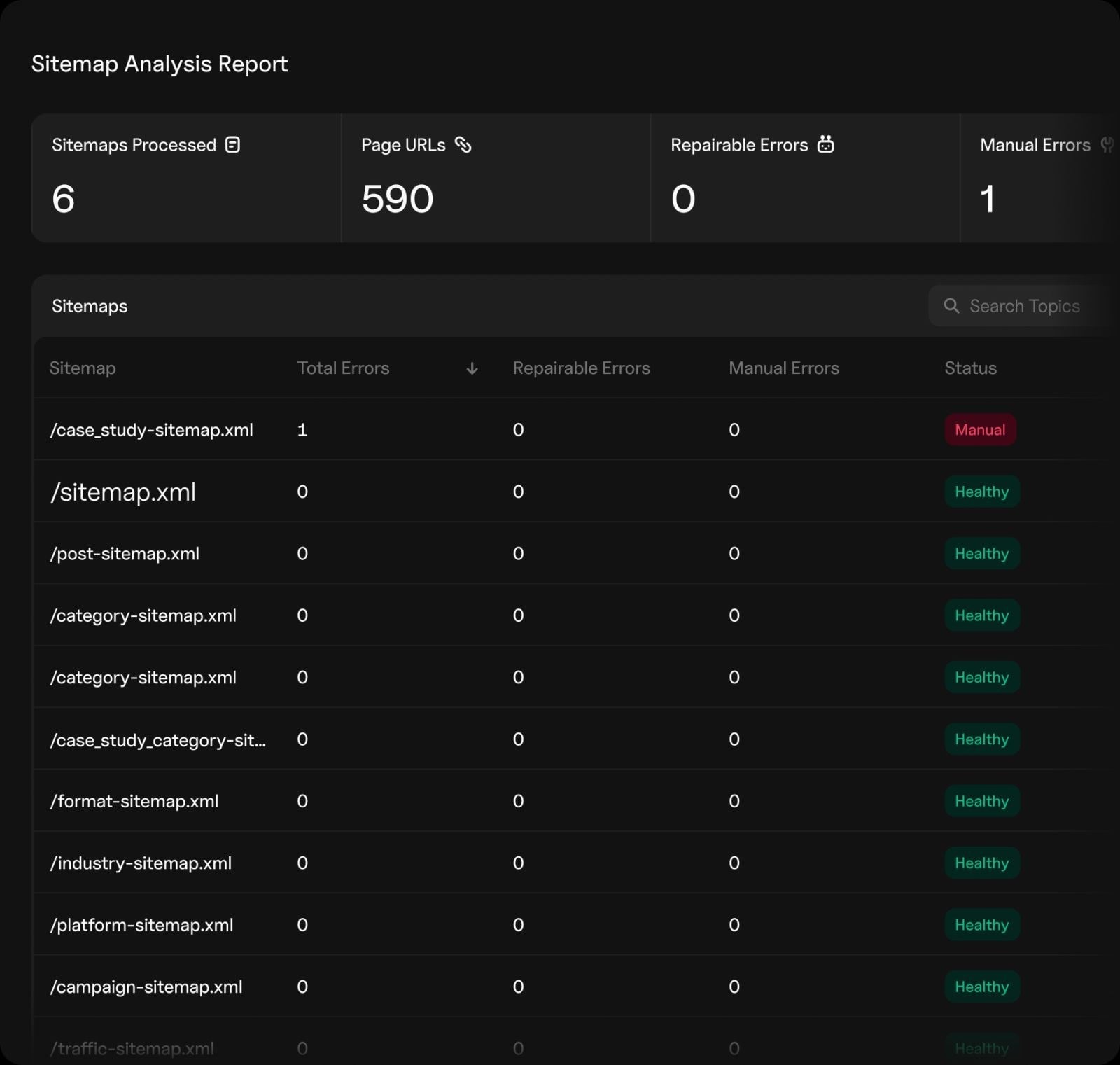
Goodie shows how AI talks about your brand across ChatGPT, Claude, Perplexity, Gemini, Copilot, Grok and Meta AI. You can research the real prompts customers use and their search volume patterns, find optimization gaps across your own and earned assets and have Goodie carry out the improvements.
Top features:
- Sitemap Analysis Report: Counts sitemaps and page URLs and lists the errors in each file.
- llms.txt checks: Reviews the file that points AI systems to the main pages.
- Daily visibility monitoring: Tracks mentions, citations, sentiment and competitors across seven AI engines.
- Traffic attribution: Connects to Google Analytics, Google Search Console and Bing Webmaster Tools.
AI SEO issues it finds:
- Broken sitemap entries: URLs that return errors or point to removed pages.
- Developer-only errors: Problems that need code changes, listed apart from the rest.
- Missing or old llms.txt: A file that does not exist or lists outdated pages.
AI SEO issues it fixes:
- Sitemap errors: Repairable errors are fixed by Goodie after approval.
- llms.txt problems: The file is created or updated.
- Content gaps: Content Studio writes and refreshes articles tied to prompts the brand is missing.
Pros:
- Fixes get done: Each plan includes a monthly quota of actions Goodie carries out.
- Proof of impact: Traffic data shows if a fix changed visits.
- Approval steps: Nothing goes live without sign-off.
- Agency plans: Built for pitching and serving several clients.
Cons:
- Higher entry price: One of the pricier starting plans here.
- Action caps: Busy months can run past the monthly limit.
Pricing: Brand Core $399 per month for 100 prompts and 10 actions, Brand Pro $999 per month for 250 prompts and 30 actions. Enterprise is custom. Agency Growth is shown at $350 per month, billed quarterly or annually.
9. Writesonic GEO
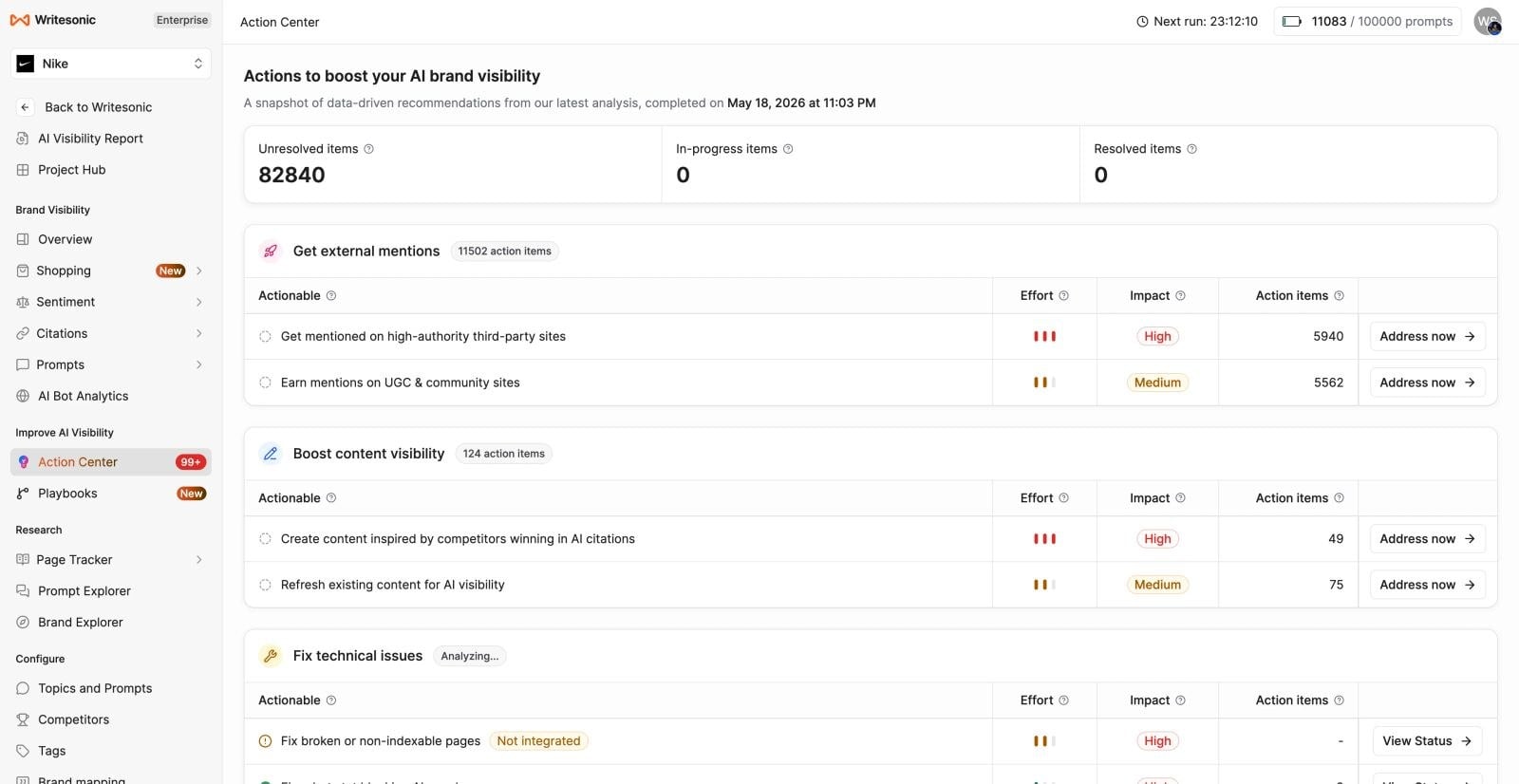
The Writesonic AI Visibility Action Center finds what hurts your visibility in AI answers, ranks each fix by impact, confidence and effort, runs the work and tracks the lift. It covers content, citations and technical issues in one place, and it watches how AI describes your brand so negative citations get flagged with fixes.
Top features:
- Robots.txt scan: Checks access for GPTBot, ClaudeBot and PerplexityBot.
- Bot-only error scan: Finds 404 and 500 responses that appear only when an AI bot requests a page.
- On-page checks: Reviews each page against more than 15 factors, such as FAQs, freshness and comparison tables.
- Citation and thread finder: Lists outside sites and Reddit threads that mention rivals.
AI SEO issues it finds:
- Blocked AI bots: Rules that stop one or more AI crawlers.
- Hidden access problems: Redirect chains and login walls in front of important pages.
- Missing citations: Sites and threads where rivals are recommended and the brand is absent.
AI SEO issues it fixes:
- Technical errors: Some fixes are applied automatically where the site connection allows.
- Weak pages: Content updates are pushed to the CMS in one click after review.
- Citation gaps: Outreach messages are drafted for sites that cite rivals.
Pros:
- Built to finish tasks: Findings come with buttons to act on them.
- Writing included: Audit, rewrite and track in one account.
- Digital PR tips: Spots media opportunities that can lead to new citations.
- Off-site gaps in the same view: No separate tool needed for Reddit opportunities.
Cons:
- GEO locked to higher plans: Lower plans do not include tracking.
- Busy interface: Many modules can feel crowded.
- Drafts need editing: AI-written updates rarely go out unchanged.
Pricing: On annual billing, Professional costs $199 per month with 100 tracked prompts and Advanced costs $399 per month with 200 prompts and sentiment. Lower plans exist but do not include GEO tracking. Enterprise starts at $1,499 per month.
10. HubSpot AI Search Grader
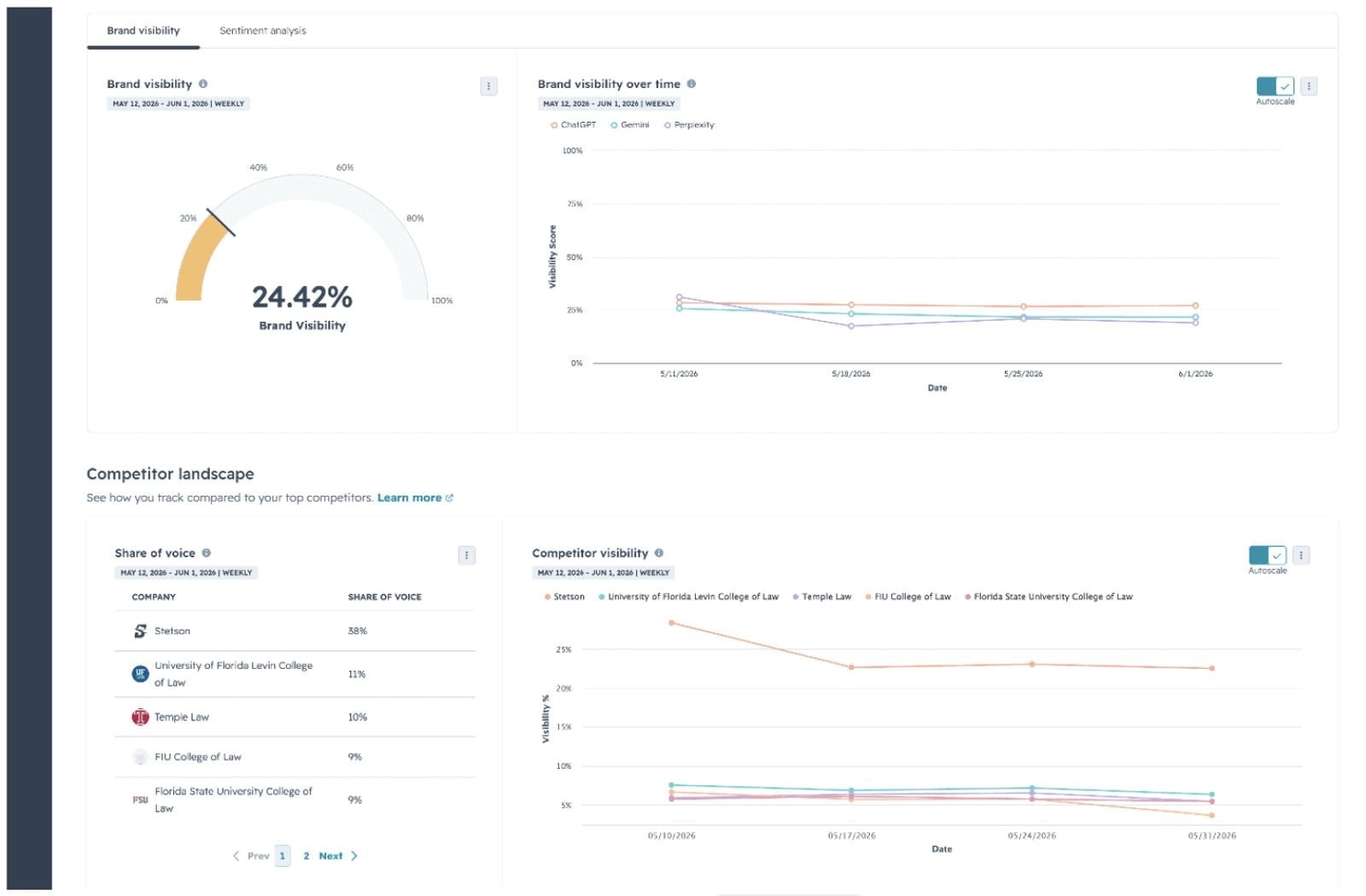
HubSpot AI Search Grader is a free, one-time check of what ChatGPT, Perplexity and Gemini say about your brand based on their training data. You enter your brand details, and it scores your brand out of 100 across five dimensions, with a written interpretation of each result.
Top features:
- Five-dimension score: Sentiment carries up to 40 points, presence quality and brand recognition up to 20 each, and share of voice and market competition up to 10 each.
- Score per engine: Separate results for OpenAI, Perplexity and Gemini.
- Sentiment layers: Splits sentiment into general tone, tone by topic and the credibility of the sources behind it.
AI SEO issues it finds:
- Weak perception: Vague or negative descriptions of the brand.
- Low awareness: Fewer mentions than rivals for the same industry questions.
- Mixed stories: Different descriptions from one engine to the next.
AI SEO issues it fixes:
- The weakest dimension: The breakdown shows which of the five dimensions drags the total down, so PR and content work can target it.
- Low share of voice: Rival mention counts point to the competitors and topics to study.
- Low-quality sources: The source quality score shows when weak sources shape the brand story, a cue to earn coverage on more trusted sites.
Pros:
- Free: No cost and no account.
- No setup: No website access or tracking code.
- Engine comparison: Shows which AI engine needs attention.
- Plain-language results: Each score comes with a written interpretation.
Cons:
- One-time check: No tracking over time.
- Lighter models: Results can differ from the full chat products.
- No technical checks: Bot access and rendering are not covered.
- Training data only: Results reflect what models learned in training, not live web results.
Pricing: Free. HubSpot AEO, the paid tracking product, has been listed from about €49 per month.
Mistakes to avoid when auditing a website for AI search engines
- Blocking all AI bots by default. Some security plugins and CDN settings block AI crawlers without any warning. Review those settings before deciding which bots to allow.
- Checking only the homepage. Product, pricing, comparison and help pages are often the ones AI engines cite. Audit the pages buyers ask about.
- Testing in a browser only. A page that looks complete on screen can still be empty in its source. View the raw HTML or fetch the page as a bot.
- Drawing conclusions from a single answer. Track the same prompts over several weeks before deciding a page has a problem.
- Tracking vanity prompts. Prompts that include the brand name will always look good. Track the unbranded questions that buyers ask before they know the brand.
- Fixing wrong facts only on the website. AI engines also quote G2, Crunchbase, Wikipedia and directory profiles, so outdated details there keep coming back.
- Ignoring server logs. Analytics tools that run on JavaScript do not record AI crawler visits. Only server or CDN logs show which pages bots fetch and which errors they hit.
- Auditing without a baseline. Record visibility scores and bot activity before changing anything. Without a starting point, the effect of a fix cannot be measured.
- Applying automated fixes without review. Tools that change robots.txt, content or CMS pages should go through the same approval process as any other site change.
FAQs
How often should an AI SEO audit be run?
A full technical check every quarter is a sensible baseline, plus a quick check after any site migration, redesign, CDN change or new security plugin. Prompt and citation tracking works best weekly or daily, so a drop after a rival launch or a model update is caught early.
Can an AI SEO audit be done without paid software?
Yes, for the basics. Reading robots.txt, fetching a page with a command-line tool such as curl using an AI user agent and asking each AI engine the target prompts by hand all cost nothing. Paid tools mainly add scale, history and competitor comparisons.
Should a site allow every AI crawler?
Not always. Publishers that sell content may block training crawlers while allowing bots that fetch pages for live answers and send referral traffic. Brands that sell products or services usually benefit from broad access, since being cited is the goal. The choice should follow the business model.
How long does it take for audit fixes to change AI answers?
Fixes to crawler access and rendering can show up within days for engines that fetch pages live. Changes that depend on model training or on new third-party mentions can take weeks or months.
Does an llms.txt file improve AI visibility?
It can help AI systems find the most important pages, but no major AI provider has confirmed that it uses llms.txt as a ranking or citation signal. It takes little effort to add, but crawlable pages, plain content and mentions on trusted sites still matter more.
Start the conversation by posting the first comment