


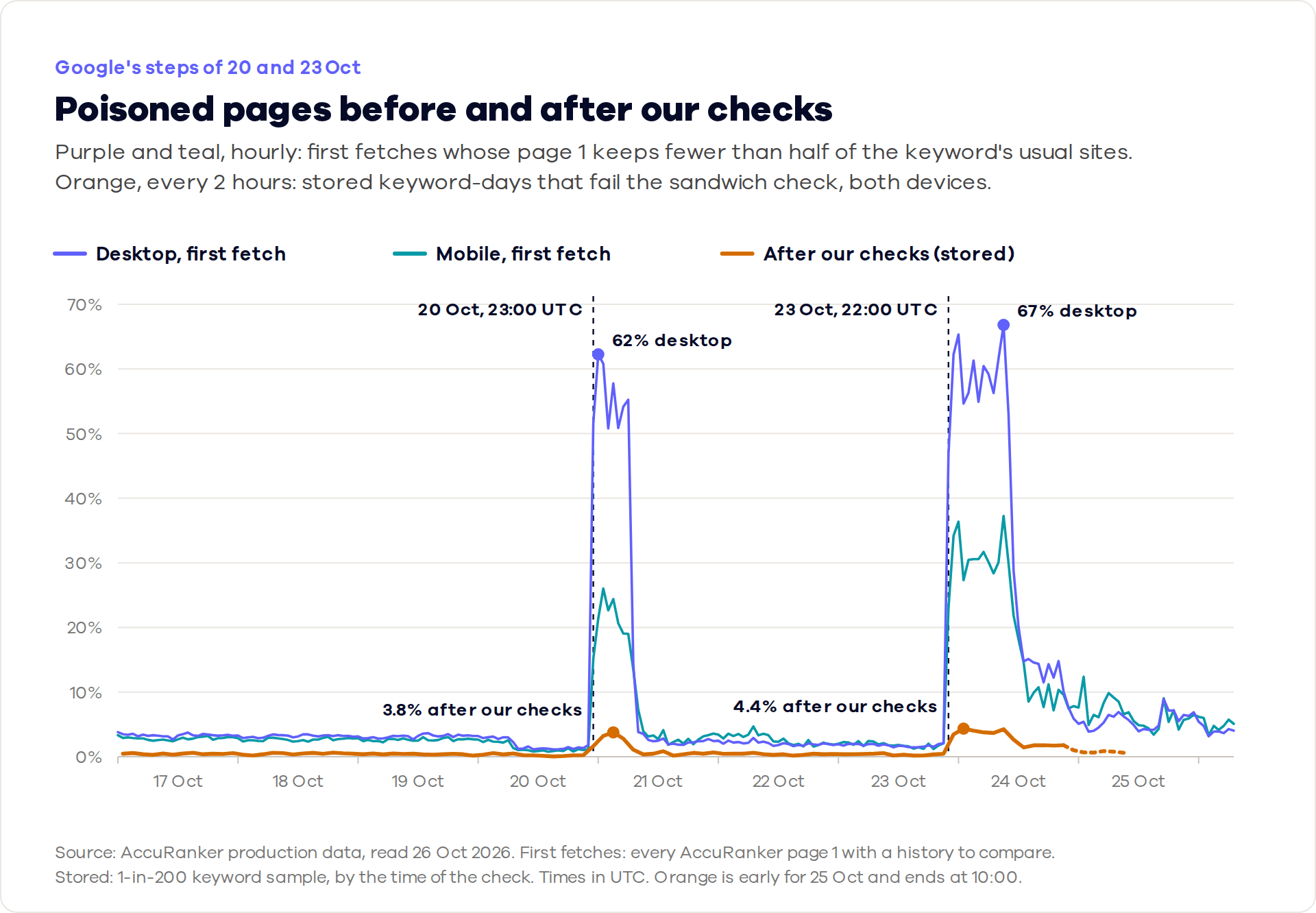
AccuRanker says bad Google data affected 40% of its initial desktop result fetches on October 24, potentially making sites appear to lose rankings. After additional checks, 3.23% of stored desktop keyword-days in its sample still showed the problem, according to its updated research.
The company calls these results “poisoned”: familiar-looking Google pages with the usual organic listings replaced. Its findings add a later spike to the misleading results reported by rank trackers earlier in October.
The initial failure rate is not your report’s error rate
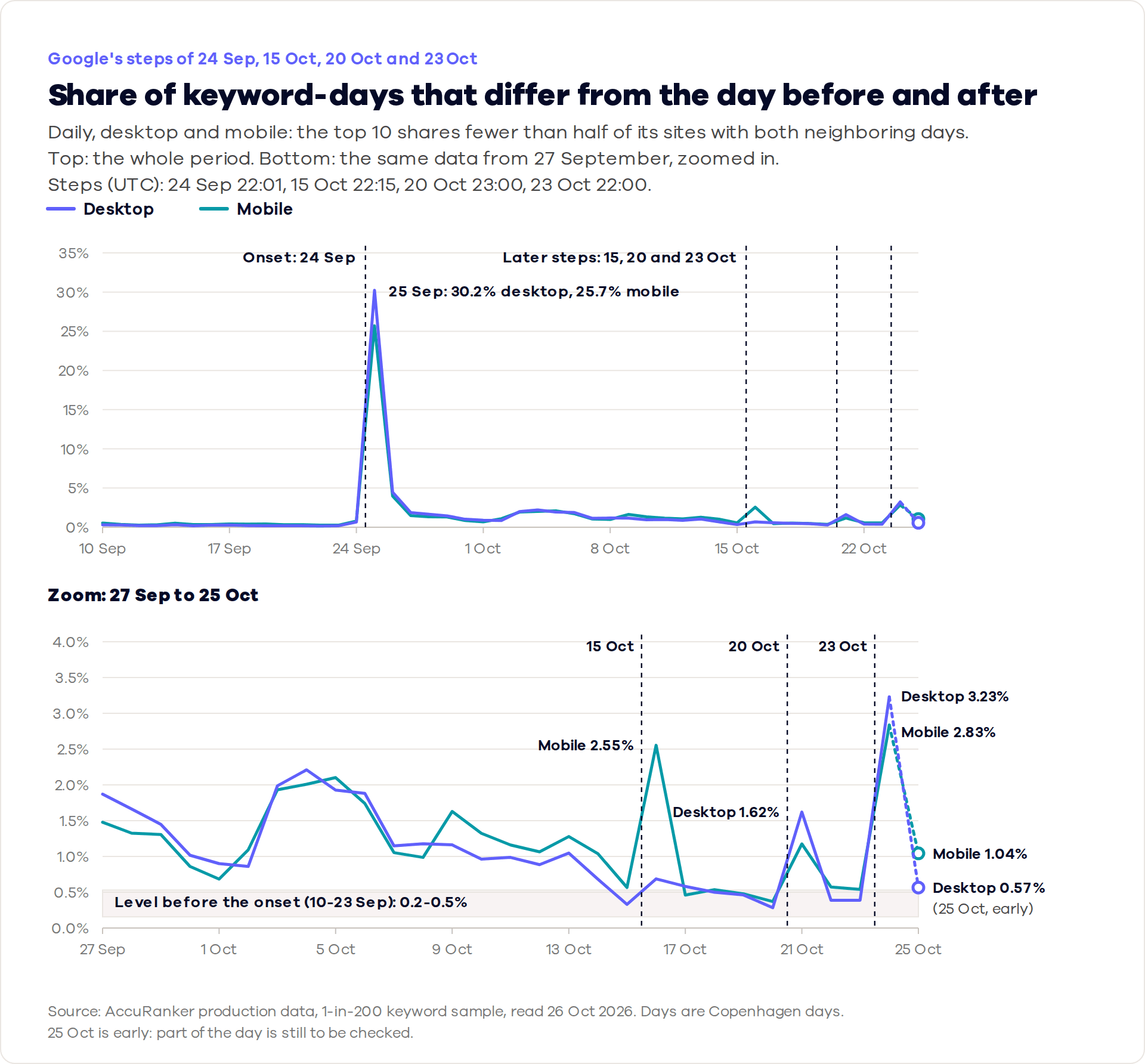
AccuRanker measures initial fetches against recent results, including only searches with enough history for comparison. Separately, it audits a fixed sample of one in 200 tracked keywords, flagging days whose top 10 retains fewer than half the sites present on both neighboring days.
Those measurements answer different questions. The first describes what the collector received; the second looks for anomalies in the records it kept. The 40% figure therefore does not mean 40% of customer rankings were wrong.
The stored-data rate fell to 0.57% on desktop and 1.04% on mobile on October 25, with those figures labeled early. A limitation of this day-to-day check is that matching abnormal results on consecutive days can escape detection.
The findings describe AccuRanker’s collection system, and its explanation of Google’s behavior remains a vendor assessment. They do not establish the error rate for another tracker or for ordinary Google users.
For anyone reporting rankings to a client, the distinction changes how to describe an alert. A sudden position loss needs corroboration before it becomes a claim that the client’s search visibility has collapsed. Keep the affected query and date attached to that investigation so a later correction can be traced.
Check the affected queries before changing your site
Google’s Search Console Performance report provides clicks, impressions and average position, with query, page, country and device breakdowns. Use comparable dates and filters when investigating the tracked query, rather than relying on a sitewide total that could hide a smaller loss.
Average position measures the topmost result from your site across impressions. It will not necessarily match a tracker’s individual observation. Google also notes that search results depend on time, place, device and recent search history.
Stable clicks and impressions are useful counterevidence to an alarming rank report, but they cannot prove every recorded position is correct. Conversely, a traffic decline deserves investigation even if a data provider is dealing with collection problems.
Google’s traffic-loss guidance recommends looking for patterns across affected pages and checking technical issues, indexing, manual actions and changing demand. It also points to reporting anomalies as a possible explanation and advises against radical changes to pages already performing well.
Check whether the newest Search Console points are preliminary before treating a comparison as settled. Google marks that data with a dotted line because it can change as collection continues.
Source: AccuRanker
Start the conversation by posting the first comment