


Mistral has launched Voxtral 3 voice agents for live customer conversations, combining speech recognition and spoken responses with tools that can act inside business systems. The October 20 announcement puts the starting voice agent API rate at $0.04 per minute when Mistral Small 4 handles reasoning.
The release includes a software development kit built on LiveKit, with support for calls and browser conversations. Mistral’s examples include checking a bill and booking an appointment while the customer is still speaking to the agent.

The reasoning model connects speech to business tools
The agent combines a real time transcription model, a general model for reasoning and tool calls, and a model that generates speech. Each stage has a separate job, so the developer can change the reasoning model or voice without replacing the whole system, according to Mistral.
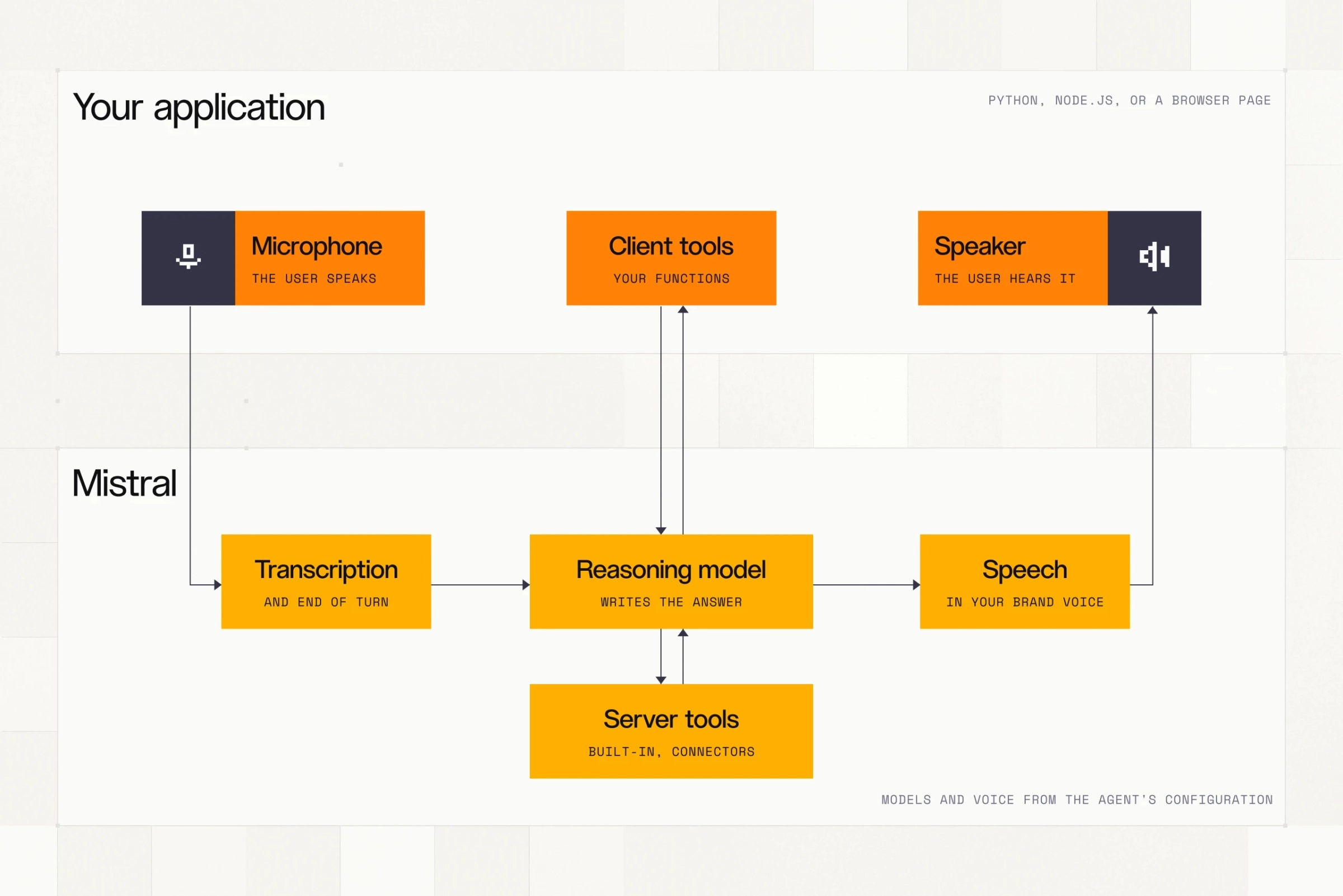
That arrangement puts the business connection between understanding a request and describing its outcome. For a booking, the calendar or reservation tool supplies the available slots and records the chosen appointment. The spoken confirmation then has to reflect the result returned by that tool, including a rejection or an unavailable time.
Voice agent and transcription rates cover different work
Mistral charges $0.08 per minute for its voice agent API with a larger reasoning model. Its separate Mini batch transcription service costs $0.0035 per minute, while Mini real time transcription costs $0.008 per minute.
| Service | Published rate | 10,000 minutes at that rate |
|---|---|---|
| Voice agent with Mistral Small 4 | $0.04 per minute | $400 |
| Voice agent with a larger model | $0.08 per minute | $800 |
| Mini batch transcription | $0.0035 per minute | $35 |
Those totals are illustrative calculations from Mistral’s published US dollar rates. The transcription row prices the conversion of recorded audio into text; the two agent rows cover a service that also reasons and responds during a conversation. At the separate real time transcription rate, 10,000 minutes would cost $80 for that speech recognition component. Telephone service, implementation and any other charges would need to be accounted for separately when costing a deployment.
A booking workflow needs a record of the action
For teams considering automated appointment calls, one useful acceptance check is whether the conversation and the booking record agree after a failed action. A demonstration can use a deliberately unavailable slot, followed by an alternative time, and compare the final spoken answer with the actual reservation. This is a proposed test, rather than a result from a Voxtral deployment.
The same check can expose a different failure from transcription accuracy: an agent may hear the request correctly but announce success before the connected service accepts the action. Measuring the completed booking and the caller’s confirmation together would capture that discrepancy.
Mistral lists European, US and global API endpoints. Customers seeking to run the full stack on their own infrastructure or in a private cloud are directed to its sales team.
Source: Mistral AI
Start the conversation by posting the first comment