

Hotels should treat Google’s proposed AI booking service as a distribution channel to measure on its own merits. Calling the reservations “direct” tells them too little about the cost of acquiring a guest or their chances of bringing that guest back.
Google’s Universal Commerce Protocol, or UCP, is being extended to let travelers book rooms within experiences such as AI Mode in Search. Google says participating businesses will retain their transactions and customer data. Its lodging page still invites businesses to a waitlist and says detailed onboarding and specifications are coming.
A booking inside Google can still belong to the hotel
Google’s proposed arrangement has real attractions. In its lodging FAQ, the company says the participating business remains the merchant of record and its own terms govern the reservation. Google also describes checking prices and availability against the business’s system before enabling the final booking button.
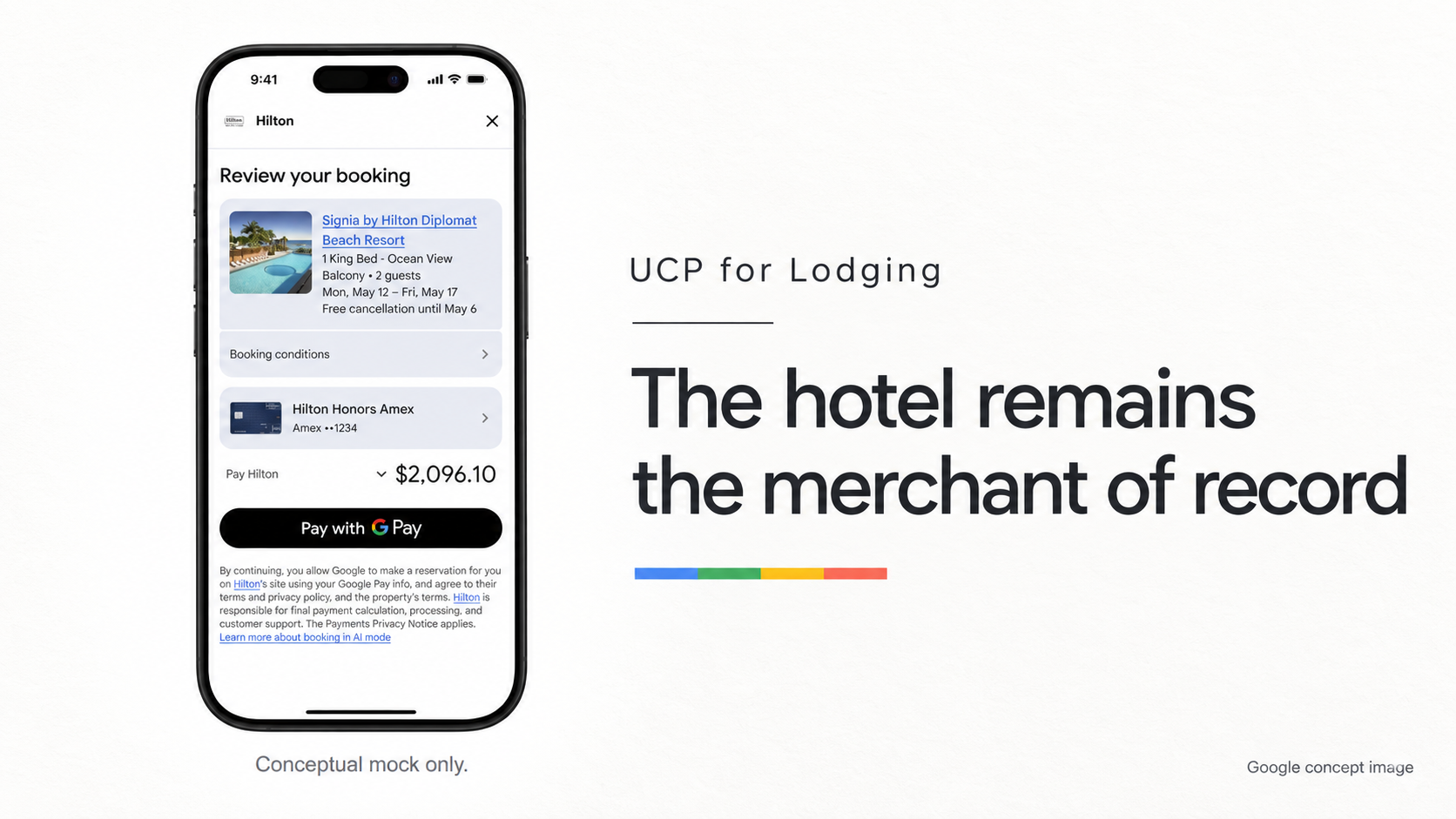
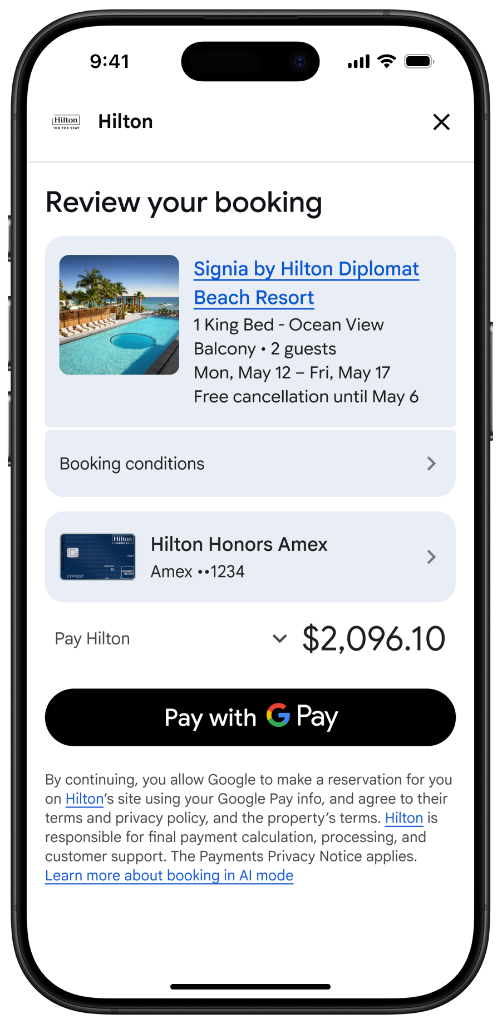
The official Hilton mockup makes the division visible: the hotel’s name appears at the top, the payment area says “Pay Hilton,” and the small print assigns payment processing and customer support to Hilton. Google labels the image a concept. It illustrates the intended arrangement, not a booking we completed.
A guest who has chosen a room has little reason to welcome another form or a slow mobile checkout. If Google can complete that reservation with fewer failures, the hotel may gain a sale it would otherwise have lost. Protecting a website visit at the expense of a profitable reservation would be a poor marketing objective.
The more difficult question concerns the next trip. A hotel can receive a guest’s details after a sale without becoming the place that guest returns to when choosing accommodation. The proposed booking flow gives Google another opportunity to be useful at precisely that moment.
Hotels have heard this pitch before
The lodging expansion was announced on May 19, 2026. The underlying commercial proposition is older.
In an October 2017 explanation of its Book on Google integration, hotel technology provider Mirai described reservations completed inside Google using hotel or online travel agency inventory. It also raised the question of whether a sale made in that interface should count as direct. The company was selling an integration, so its account is useful evidence of the arrangement, not an independent assessment of its success.
That history matters because removing the click to a hotel website is not, by itself, an AI breakthrough. The stronger case for the current proposal is that a conversational assistant could help someone choose a suitable room and then complete the reservation. Whether travelers find that useful, and whether hotels earn more from it, requires evidence from actual use.
There is no need to assume every Google shopping experience will keep every customer inside Google, either. SEW has separately documented limited AI Mode behavior that sends shoppers straight to retailer websites. Hotel booking integrations deserve to be assessed specifically, rather than folded into a prediction that all outbound clicks will disappear.
An open protocol does not guarantee an independent sales channel
UCP’s open design is a substantive point in its favor. Its technical documentation describes businesses exposing capabilities that compatible platforms can discover and use. The aim is to reduce the need to build a separate connection for each platform. UCP itself should not be confused with a Google-only checkout product.
For a hotel or its booking technology provider, that could make an integration useful beyond one search service. It weakens the argument that adopting UCP necessarily means committing the business exclusively to Google.
Commercial dependence can nevertheless grow without exclusive technology. If guests repeatedly start and complete their room searches in Google, the hotel depends on appearing in that experience even when the connection underneath is portable. Another assistant’s ability to access the same inventory would help only if enough travelers chose to use it.
Google also explicitly says UCP integration will not affect how it ranks properties or rates. Integrated offers get a direct booking option. Hotel marketers should therefore question any claim that implementing UCP buys a ranking advantage. The promised benefit concerns the booking process.
Judge the channel by the guests it brings back
I would want a hotel’s UCP bookings reported separately from reservations completed on its own website. Google’s FAQ says its transaction events can distinguish the channels. Combining them under a reassuring “direct” total would conceal whether the hotel was building its own demand or relying more heavily on Google.
The comparison should follow profit after acquisition and integration costs, including cancellations. It should also track what happens when those guests book again. A channel that introduces new guests who later return through the hotel’s own website can justify a very different investment from one that repeatedly acquires customers the hotel already knew.
Neither outcome can be read from a checkout mockup. A rise in Google-completed reservations could reflect additional business, displaced website bookings or a mixture of both. Counting the reservations alone would not separate them.
Start the conversation by posting the first comment