Guide to Google ranking factors - Part 1: On-page factors
Today we begin a mammoth task in presenting to you a breakdown of every single ranking signal Google uses to determine where your site and its content appears in search results pages (SERPs).
Today we begin a mammoth task in presenting to you a breakdown of every single ranking signal Google uses to determine where your site and its content appears in search results pages (SERPs).
Today we begin a mammoth task in presenting to you a breakdown of every single ranking factor Google uses to determine where your site and its content appears in search results pages (SERPs).
In fact it’s such a mammoth task, we’re dividing the signals into manageable, neatly categorised parts – which will eventually culminate in a gigantic, all-conquering dossier of every Google ranking signal.
There are likely to be hundreds of signals, and we’ll never be 100% sure of everything that comes into play. Also the algorithm changes thousands of times a year, so this will be a constantly evolving document. But we will do our best to be as up-to-date and accurate as possible.
Future instalments will specifically cover content, links, machine learning, site-wide factors, domain factors, mobile, speed, local, social… phew, let’s not get ahead of ourselves.
First let’s look at the simple, technical elements Google uses to rank your page.
As I’ve already discussed in our guide to writing title tags, these are used to tell search engines and visitors what your webpage is about in the most concise and accurate way possible.

According to Moz, title tags have “long been considered one of the most important on-page SEO elements.” Here’s what you need to know about how they affect your ranking…
1) You need to include any keywords you wish to rank for in the title tag.
2) The closer to the start of the title tag any given keyword is, the more likely it will be to rank for that keyword based query.
Primary Keyword – Secondary Keyword | Brand Name
3) Your title tag needs to be written for humans – as in it needs to make logical sense, rather than a keyword stuffed mess.
Your title tag will appear in a variety of places, from SERPs, to a social share, to the browser tab, so make sure it’s relevant and readable.
4) Do not duplicate your title tags across your website as this can adversely affect your visibility.
Important elements that aren’t necessarily signals, but will affect click-through:
The difference between a H1 tag and a title tag is simple: title-tags appear in search results and the H1 tag is what visitors see on the page. Your headline or webpage name will (in the majority of cases) form your H1 tag.
Here’s what you should know about H1 tags:
5) Your target keywords should be in the H1 tag.
6) Your H1 however can be different from the title tag. It doesn’t have to be – you won’t be penalised for having the same title tag and h1 tag for a web-page (after all, most CMS generate this automatically) – but varying the keyword phrasing of both can increase your chances of appearing for different search intents.
7) Only use one H1 tag per-page. (Although this isn’t strictly true if you’re using HTML5 where you can use one H1 per section).
8) Break up the main body of your articles by using plenty H2 and H3 tags, but try to use them in a descending, logical order.
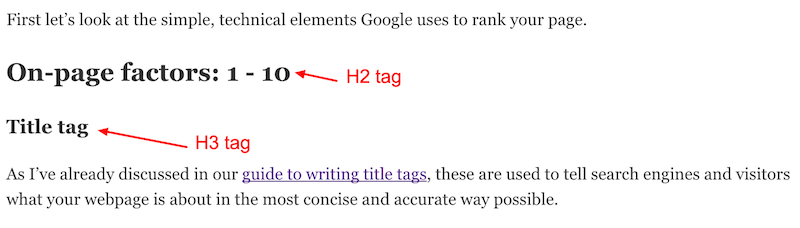
9) Your H2 and H3 tags should also contain relevant keywords too. Although you shouldn’t repeat yourself, there should still be words and phrases you wish to rank for.
10) A meta description is the short paragraph of text placed in the HTML of a webpage that describes its content.
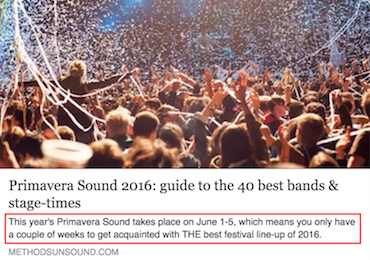
Google has stated that meta descriptions are NOT a ranking signal. But, the quality of the description will influence click-through rate, so it is very important to use this element wisely…
Next time we’ll look at even more on-page ranking signals.
Part 10: Backlinks
Part 9: Outbound links
Part 8: Internal links
Part 7: Site-level signals
Part 6: Trust signals, authority and expertise
Part 5: Duplicate content and syndication
Part 4: Content freshness
Part 3: Quality content
Part 2: Keyword relevancy, frequency and Latent Semantic Indexing (LSI)
Leave a Reply
You must be logged in to post a comment.