


With Seymour, SEW’s AI learning companion.
AI citations are references an AI answer provides to identify its sources. In AI search, they usually appear as clickable numbers, links or source cards. Click one and you can open a page associated with the answer, see who published it and check the information for yourself.
For a website owner, a citation is also a possible route to a new reader. Your page might supply a detail in someone’s answer, and its source link gives that person a way to visit you.
Picture an answer about email software. Beside a sentence about a free plan, there’s a small [1]. That little marker is doing a useful job: it points you toward the page offered as evidence for the claim. Of course, in the future this might change, and there might not be numbers.
What does an AI citation look like?
A citation might be a numbered marker at the end of a sentence, a publisher’s name you can click, or a card containing a page title and website. Some answers also have a separate sources panel. The presentation varies between products and can change as interfaces are updated.
ChatGPT’s search documentation says citations appear when it uses web search. Perplexity describes its Pro Search answers as including direct source links. Google’s AI Overviews and AI Mode guidance describes links to supporting websites.
To see the relationship, imagine a fictional email tool called Acorn Mail. You ask whether its free plan would work for a team of two. An illustrative answer says:
“Acorn Mail’s free plan supports up to three users, so two people would fit within that limit. [1]”
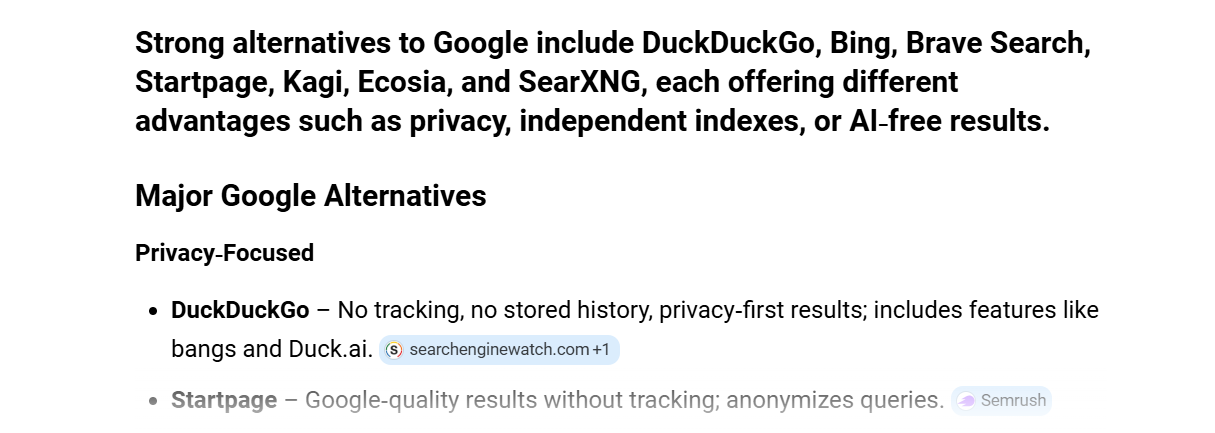
The above examples shows SearchEngineWatch.com inside a citation.
The citation leads to a fictional pricing page showing a three-user limit. That page supports the detail about users. You’d still need to check other requirements, such as how many contacts or monthly emails the plan allows, before choosing the tool.
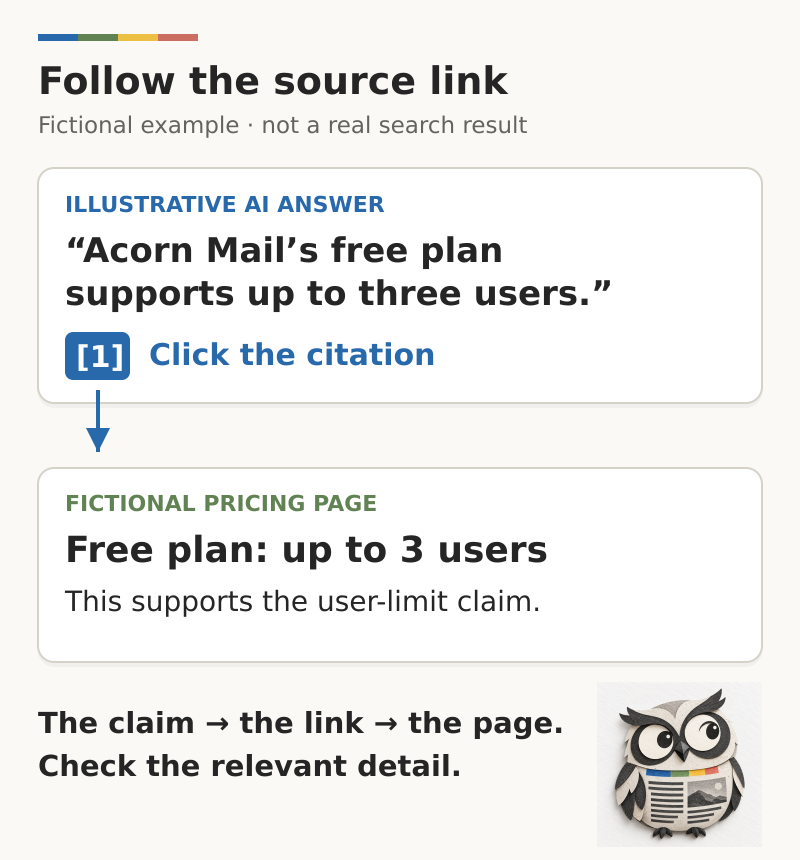
Notice the job of the source link: it lets you investigate a particular part of the answer. One source attached to a paragraph may support only some of its claims.
How do sources end up in an AI answer?
Many AI search experiences combine finding information with writing an answer. A useful way to picture the process is: the system searches for relevant material, uses information from the results and presents an answer with selected source references. Real systems can repeat those steps as they investigate a question.
Google calls one part of this process retrieval-augmented generation, or RAG. In its guide to generative AI search, Google explains that its systems retrieve pages from the Search index, review information on those pages and show links that support the response.
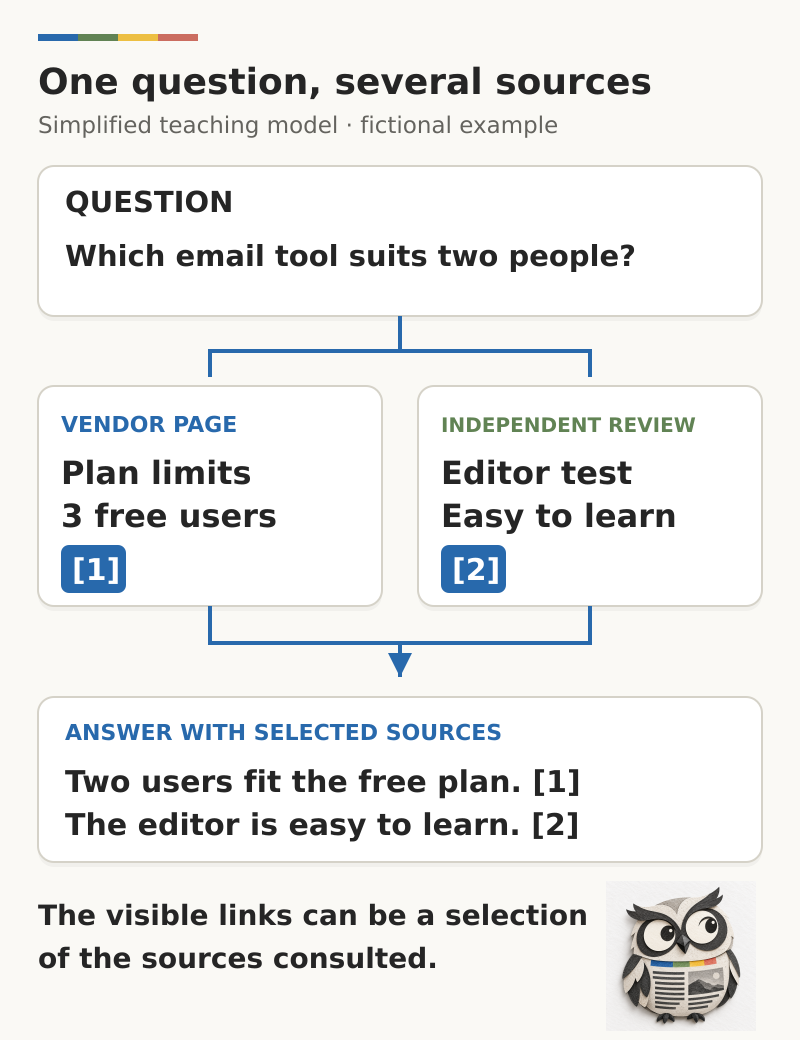
Return to our email-software question. A vendor’s pricing page might answer how many users the free plan allows. An independent review might explain how easy the editor is to use. An answer comparing options could draw on both kinds of information.
A broader question may lead to several related searches. Google says AI Overviews and AI Mode may use this technique, called query fan-out. Our plain-English explanation of query fan-out walks through how one question can branch into several searches.
Does the answer show every page the AI consulted?
The visible citations can be a smaller selection. For example, OpenAI’s API web-search documentation distinguishes the URLs consulted during a search from the references shown as inline citations. It says the number of consulted sources is often greater than the citation count.
That distinction helps explain why inspecting the finished answer gives you only part of the picture. If your URL is missing from the citations, the answer itself doesn’t tell you whether your page was never found or was considered without receiving a visible link. We explored that publisher problem in our reporting on content being retrieved without a citation.
What about the model’s training?
Training helps a language model learn patterns it can use to generate text. Searching for a source during an answer is a separate activity. A visible citation gives you a reference to inspect; it doesn’t provide a record of all the material involved in training the model.
OpenAI makes the distinction concrete in its crawler documentation: OAI-SearchBot is used for ChatGPT search, while GPTBot crawls content that may be used for model training. Website owners can manage those permissions independently.
A mention, a citation and a click tell you different things
An AI answer could name your business while citing a review on someone else’s website. It could also cite your research while recommending a different product. Look at both the wording of the answer and the destination of its links.
| What happened? | What it tells you |
|---|---|
| Brand mention: the answer names Acorn Mail. | The brand appears in the answer text. |
| Citation: a source link points to Acorn Mail’s pricing page. | The answer presents that page as a source. |
| Recommendation: the answer suggests choosing Acorn Mail. | The answer favors that option in this particular context. |
| Referral visit: someone follows the link to the website. | A person has arrived from the answer. |
For a publisher, a citation may credit a useful piece of reporting. For a software company, the more valuable appearance might be a recommendation for a buyer whose requirements match the product. In either case, the reader can finish with the AI answer and leave without visiting the cited website.
How is an AI citation different from a backlink?
A backlink is a link to your page from another website. An AI citation is a source reference shown within an AI-generated response. Both can give someone a route to your page, but their context and reporting differ.
A citation you see in one answer records that appearance. It doesn’t tell you that the same link will appear for every person asking a similar question. Keep examples from AI answers in your visibility records, alongside any referral visits you can identify.
How do you check whether a citation supports the answer?
Open the source and compare its wording with the exact claim. That sounds obvious, but a link placed beside a confident sentence is easy to skim past.
In a 2023 study of four generative search engines, researchers found both unsupported statements and citations that failed to support the sentences attached to them. Those findings concern the systems tested at that time. They illustrate the reason for checking the claim against the page.
Imagine our fictional Acorn Mail answer now says its free plan includes unlimited users. The linked pricing page says the free plan allows three users and the paid plan allows unlimited users. The page exists and covers the right product, but the answer has assigned the paid-plan benefit to the free plan.
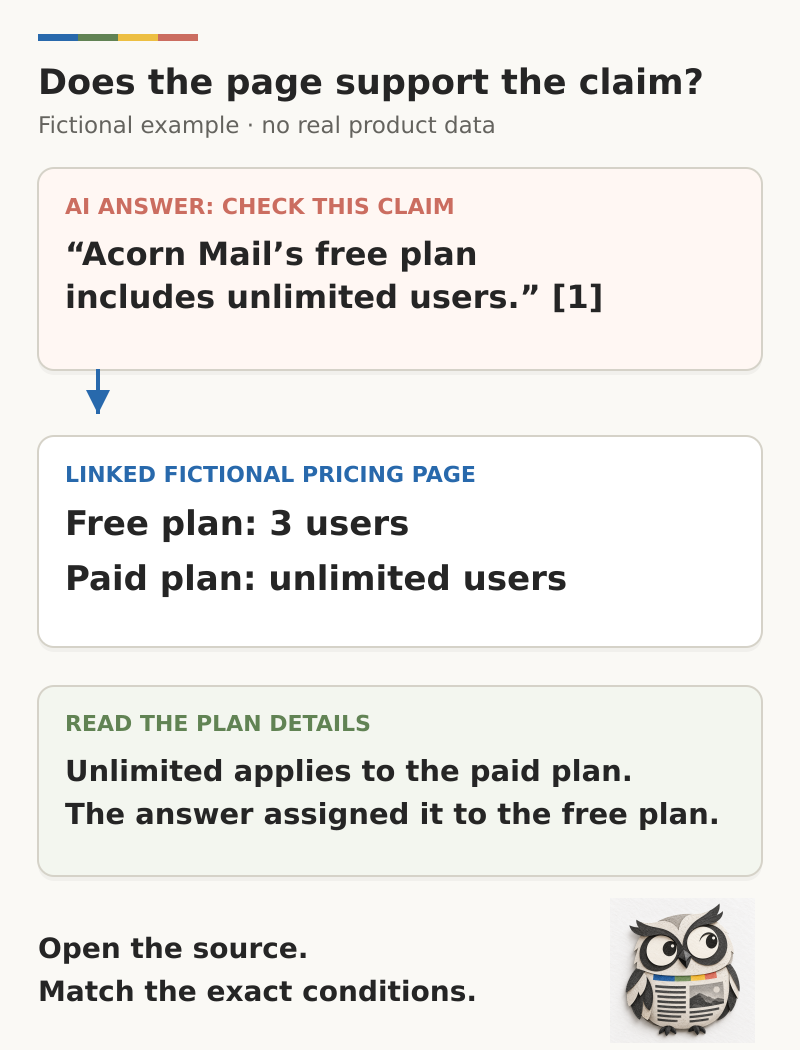
When checking a citation, follow these four steps:
- Open the destination. Check that the page exists and belongs to the publisher the answer identifies.
- Find the supporting passage. Look for the sentence, table or result behind the claim. A page on the same subject may still say something different.
- Match the conditions. Compare dates, product versions, countries, plans and units. A statement about a paid plan won’t answer a question about a free one.
- Follow the evidence upstream when needed. If the page summarizes a study or announcement, open the original and check its scope.
If the destination is inaccessible, you may be able to find an accessible original source. Until you can inspect the relevant evidence, keep that claim unresolved.
How can you make your pages useful as AI sources?
Start with a real question your page can answer and evidence that helps someone answer it accurately. For Acorn Mail, that could be a pricing page with clear limits for each plan. For an independent reviewer, it might be a documented test of an email editor, with the version tested and screenshots showing the task.
Those details make the source useful to a reader who follows a citation. They also give a search system concrete information to retrieve. Selecting your page still depends on the question and the platform.
Check whether the platform can access and include your content
Google’s AI-features guidance says a page must be indexed and eligible for a search snippet to appear as a supporting link in AI Overviews or AI Mode. Its current Search generative AI control documentation also explains the inclusion setting in Search Console. Inclusion is the default for top-level properties; a child property may inherit its parent’s choice.
For ChatGPT search, check the OAI-SearchBot rules described in OpenAI’s crawler guidance, along with any server or security rules that might block access. OpenAI says sites opting out of that bot won’t appear in ChatGPT search answers, although navigational links may still appear.
Publish information someone can inspect
Say what you tested, where a figure came from and which conditions apply. If you publish a survey, include who responded, when it ran and the questions asked. If you cover a software feature, show the relevant plan or version. If a price changes, update the page and make the current amount clear.
For our fictional tool, “Our free plan is ideal for growing teams” leaves the reader guessing. “The free plan allows three users and 500 contacts” gives them two limits they can compare with their needs. Those invented figures are a teaching example, not an observed product offer or citation result.
Organize the page around those questions with descriptive headings and readable tables where they help. Keep the evidence near the statement it supports, so a person arriving halfway down the page can understand it.
Keep the page readable for people
Google’s current optimization guide says you don’t need llms.txt files, special AI markup, an ideal page length or artificially chopped-up content for its generative search features. It also warns against producing pages for every query variation primarily to manipulate results.
How do you measure AI citations?
Begin with a small, repeatable set of questions relevant to your work. Save the answers and their source links, recording the platform, date, wording, language, location where relevant and whether web search was used. Repeat under comparable conditions, keeping each platform’s observations separate.
Define what you’re counting. You might count answers that contain at least one citation to your domain, distinct cited URLs, or individual citation markers. Those totals can differ when one answer cites several pages from the same website.
Here’s a simple illustrative example: you save 20 answers from one platform, and five contain at least one citation to your website. Your answer-level citation rate in that sample is:
5 ÷ 20 × 100 = 25%
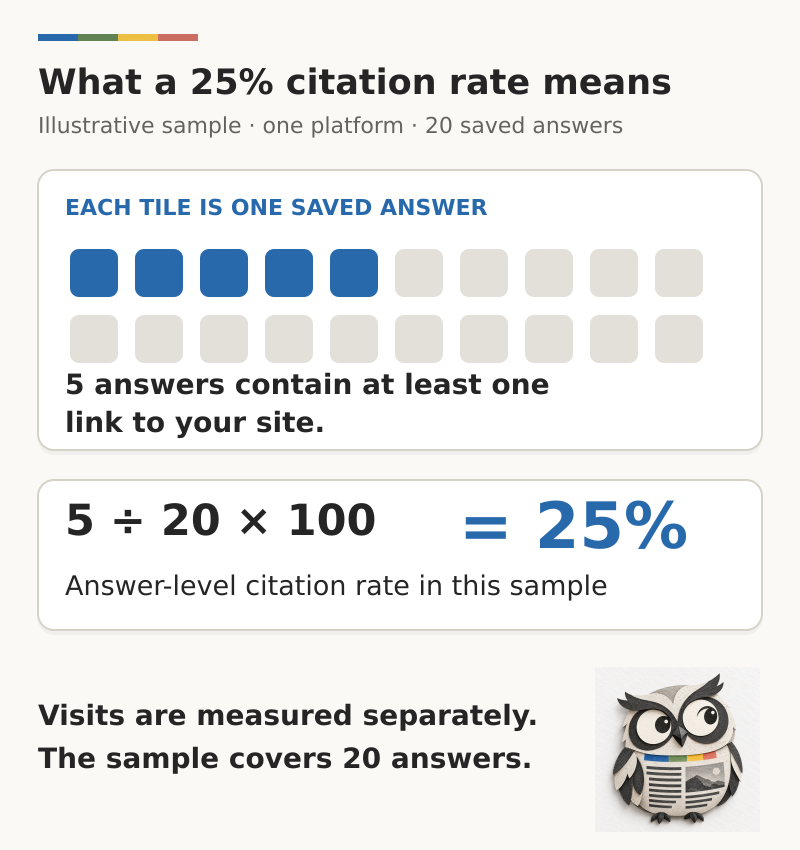
The percentage describes those 20 answers. Keep the prompt list and collection conditions with the result so the next sample is comparable. A tracking tool’s figure needs the same scrutiny: check its prompt coverage, platforms and counting method.
Measure visits and useful actions separately. Website analytics can help you identify reported referral traffic and what those visitors did, although referral information can be incomplete. An answer-level citation count won’t tell you how many people clicked.
For Google, the Generative AI performance report documentation describes impressions for AI Overviews and AI Mode. It says the report may be absent when a property has too few impressions, and also retains a rollout-access caveat. These impressions measure links being shown under Google’s counting rules, rather than appearances in your saved prompt sample.
Common questions about AI citations
Can an AI cite my website without naming my business in the answer?
Yes. The answer could use a fact from your page and link to it while discussing the subject rather than your business. Inspect the answer text and source links separately.
Can my brand be mentioned while another website receives the citation?
Yes. For example, an answer about your software could link to an independent review. Record the brand mention and the cited destination as separate observations.
Will adding sources to my article make AI cite it?
Sources let readers inspect your evidence and give your claims a clearer basis. Whether an AI answer links to your article depends on its retrieval and source selection. Adding a bibliography provides no guaranteed placement.
Can AI invent a reference?
Yes. A 2023 study of bibliographies generated by GPT-3.5 and GPT-4 found fabricated references as well as errors in real references. It examined older models writing literature reviews, rather than today’s web-search answers. Open and verify a reference before relying on it.
Is this the same as citing ChatGPT in an essay?
That is a separate question about acknowledging your use of an AI tool. Here, we’re explaining references an AI answer provides to other sources.
What should I do first?
Choose one question your website answers well. Look at an AI search answer to that question, open its citations and compare the linked pages with yours. You’ll see what information those sources provide and whether your own page offers a clear, supported answer.
Start the conversation by posting the first comment