

Google has not confirmed a new search update in October 2026, despite a growing number of site owners who believe one is underway. As of October 19, the Google Search Status Dashboard lists the September 2026 spam update as its most recent ranking incident, and Google marked that rollout complete on October 8. Site owners reporting on search forums are nonetheless describing collapsing Discover traffic, Google News results stuck on old stories, and Search Console data running days behind.
The most recent posts have turned from describing the aftermath to predicting the next change. “Seems like a Core update on the way,” one member wrote on October 19, a day after another said “there is an update on the way. If it isn’t running already.”
Google’s dashboard lists no October update
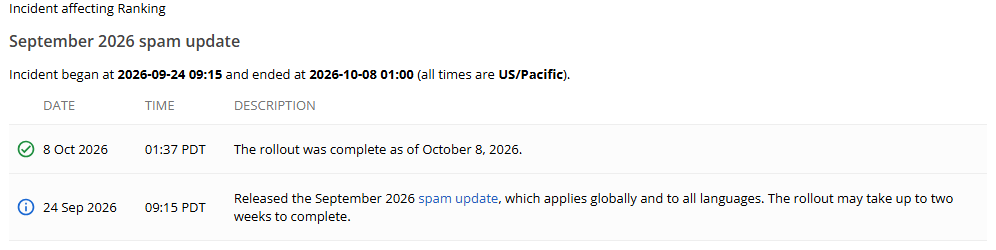
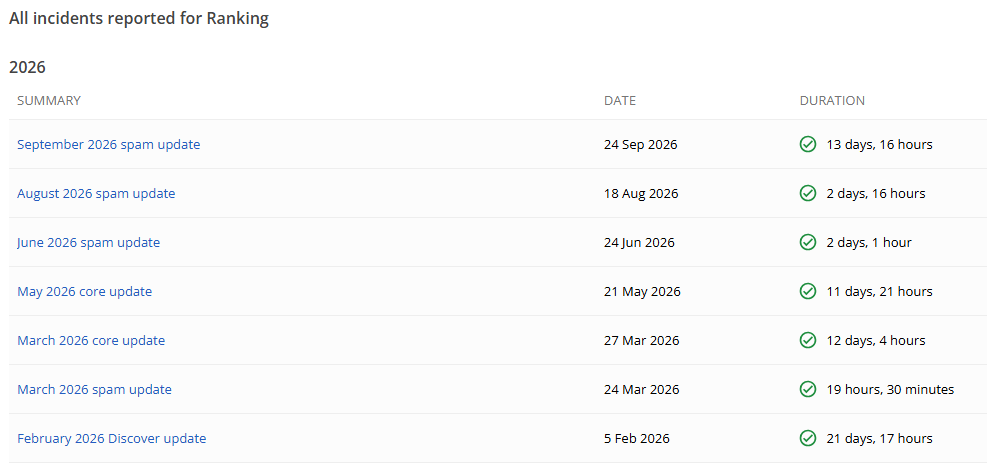
Google released the September 2026 spam update at 9:15 a.m. Pacific on September 24, saying it “applies globally and to all languages” and could take up to two weeks. The dashboard entry closed on October 8 with a single line: “The rollout was complete as of October 8, 2026.” At 13 days and 16 hours, it was the longest spam update rollout of the year, against under three days each for the June and August spam updates.
The last core update on the dashboard is the May 2026 core update, which started May 21. Before that came the March 2026 core update and, in February, a Discover-specific update that took almost 22 days. Nothing dated October appears in the ranking, crawling, indexing or serving histories.
Search Console’s own data anomalies page has no entries for September or October either. Its last notices cover an August 13 logging error that cut reported Discover clicks and impressions, and an August 13 to 17 gap in the Generative AI performance report, which Google said was restored on August 21.
Site owners report Discover, News and Search Console problems
Not everyone sees a problem. One forum member who said he had reviewed more than 100 Search Console accounts put the change at a decline of “maybe .5 to 1%” over a long window, with most sites “going UP in traffic not down.”
Other reports tell a less comfortable story for news publishers in particular:
- Discover. Several members describe Discover as erratic since late August, with “just a handful of discover spurts in the past two months.” On October 17 one asked whether Discover traffic had “entirely disappeared” for two days.
- Google News. Members report News surfaces showing stories that are days, a week, or in one claim three months old, and indexing that lags behind publishing.
- Search Console delays. Reported lags range from 52 hours to about a week. Google has not acknowledged a reporting delay for this period.
- Traffic without sales. Two members describe visitor numbers holding while conversions fall, one saying sales had declined for four weeks “not in visitors,” with traffic swinging “from high to low and back every 1-2 hours.”
- Rankings versus clicks. One publisher said Sistrix showed its visibility index “skyrocketing” while actual traffic stayed minimal. Another said rankings were unchanged but traffic fell, and blamed added AI Overviews.
Not every report is negative. One member running a 22-year-old site with 673,000 indexed pages said traffic was “up over 35% and increasing,” with AdSense revenue up 60% year over year, gains he traced to changes in July and early August.
Most complaints started before the spam update
The two accounts are less contradictory than they look. The status dashboard only records changes Google chooses to announce: named core, spam and Discover updates, plus serving incidents. Google ships ranking changes constantly without posting them there, so an empty October column means there is no announced update, not that nothing has moved.
The pattern in these reports also points away from a single ranking update. The most specific complaints concern Discover and Google News, which are fed by systems separate from the core web ranking that a core update targets. The timeline most members describe also starts in late August, a month before the spam update began.
A ranking change cannot explain a visibility index that rises while clicks fall, or traffic that holds while sales disappear. Those are more consistent with changes to the results page itself, such as more AI Overviews, ads or local units taking the clicks, or with bot traffic distorting analytics. Several of the same site owners were writing Cloudflare rules to keep scrapers out, and bot filtering can skew SEO reports in ways that look like ranking losses.
Forum reports also skew toward the sites in trouble. As one member put it, “The noise after every update usually says more about who’s posting than about what changed.”
Compare Search, Discover and News before blaming an update
For a site seeing sharp swings this month, the useful comparison is between surfaces. In Search Console’s Performance report, filter Search, Discover and Google News separately: a drop confined to Discover or News is a different problem from a drop in web search clicks. If web rankings hold while clicks fall, check the queries that lost clicks for new AI Overviews or ad placements. If analytics and Search Console disagree, look at server logs for bot traffic before reading anything into the totals.
A core update, if one comes, will appear on the Search Status Dashboard with a start time. Until it does, any October update is a forum prediction rather than a confirmed event.
Source: WebmasterWorld
Start the conversation by posting the first comment