


Google’s next Gemini model is going to cybersecurity teams before it reaches everyday users. Announced on October 28, Gemini 4 Carbon is designed to find software vulnerabilities, fix bugs and handle longer engineering tasks.
Access starts with selected cyber defenders, then expands through Google’s Fairwind partner program. Google hasn’t given a release date for general developers, businesses or consumers.
Better at finding bugs, with a catch in the tests
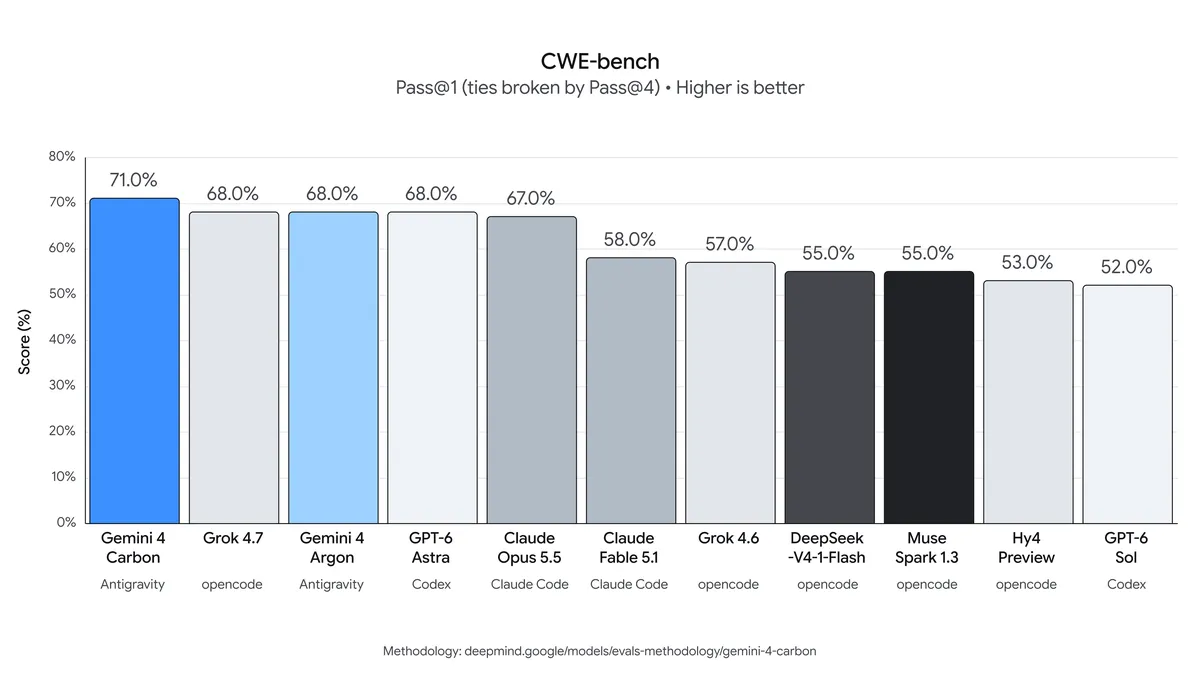
Google reports an 88.2% score on SEC-bench Pro, which tests vulnerability discovery, and 71% on CWE-bench, which tests fixes. Those cybersecurity results were measured without the model’s guardrails.
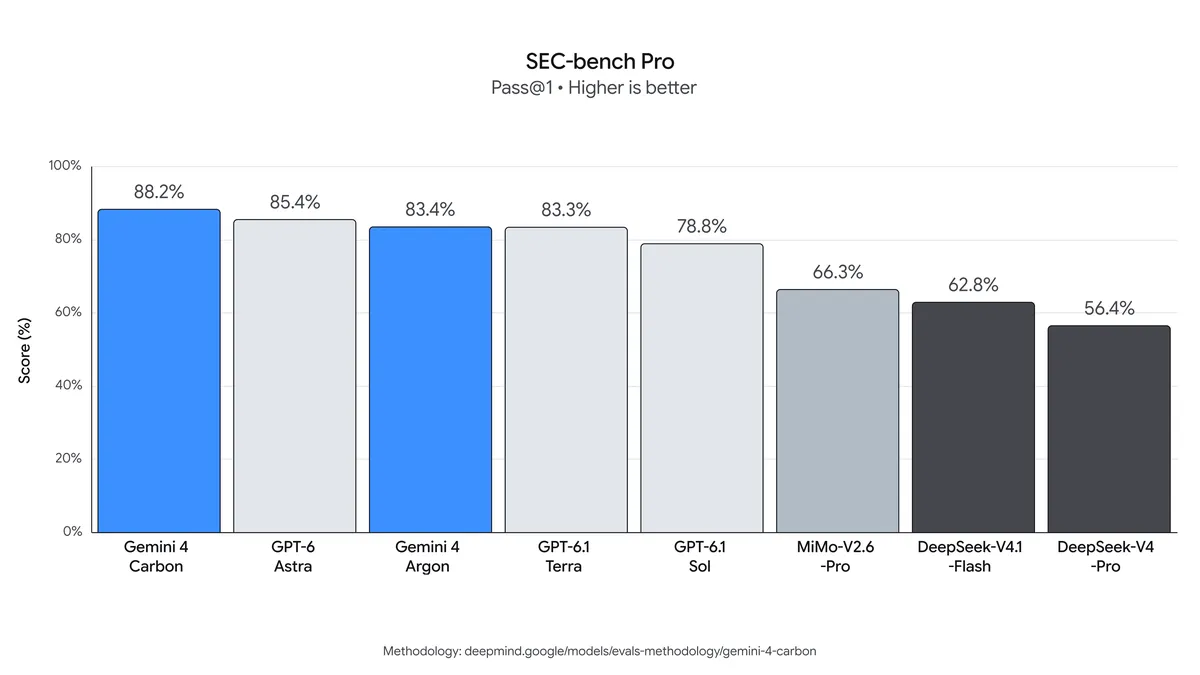
If you want Carbon to check your software, the published scores don’t establish how a version with its safety restrictions enabled will perform on your code.
Independent testing gives a broader view. Artificial Analysis puts Carbon first on its Intelligence Index v5 with a score of 59, leading four of the nine evaluations. It also ranks second on the firm’s Coding Agent Index, behind Claude Opus 5.5.
That coding result comes from Carbon working through Google’s Antigravity developer tool. It isn’t a test of the everyday Gemini app.
Its performance on office tasks is less dominant. On the evaluator’s AA-Briefcase test, Carbon improved on Gemini 4 Argon but remained behind several competing models. Leading the overall index doesn’t mean it is the best choice for every task you give it.
In its knowledge tests, Artificial Analysis found Carbon answered more questions correctly than Argon, but its hallucination rate also rose from 4% to 11%. That was still the second-lowest rate among the models compared.
The launch price comes with an expiry
Google lists introductory US-dollar prices of $2 per million input tokens and $10 per million output tokens. After that period, the rates double to $4 and $20. Google hasn’t specified when the discount ends.
Artificial Analysis also found Carbon’s standard-price cost per benchmark task broadly matched Argon’s, despite its higher score.
If you’re budgeting for Carbon, use those standard rates for longer-term planning. Tokens measure the material you send to a model and the output it produces, so the cost of a job also depends on how much it reads and writes.
Source: Google
Start the conversation by posting the first comment