
Please note: We have now published an updated version of this article: Ten steps to successful SEO for startups
You’re starting a new business. You have a great idea or product, some money to invest, eager customers, and great workers.
With the business model and process elements covered, now is the time plan out how to succeed in search and discovery digital contexts.
Many elements are required to do well nowadays need to be built-in to your site and off-site properties, so here is an outline on how to build a new business that will do SEO right.
Step 1: Know Your Concepts and Keywords
Start by determining what customer behaviors you want to be a part of and what concepts you want to be associated with.
This is bigger than just keywords and keyword research. People, content, functionality, open data, and a bunch of other things will get you business into the conversations you care about.
For the sake of clarity, let’s say you’re starting a new business based on selling new and used cars and operating car dealerships. Here’s what a concept map might look like:
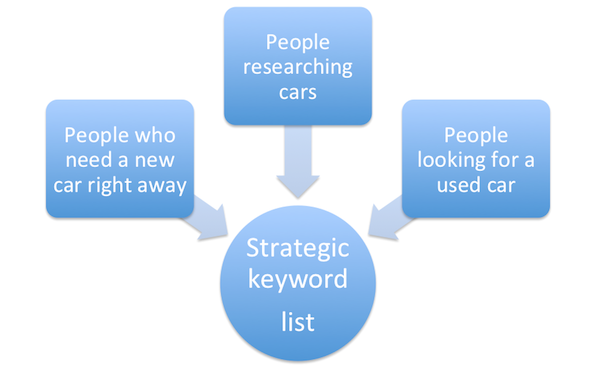
Take the concepts and behaviors you want to be associated with and build a list of strategic keywords. You will use these keywords for a lot of different purposes later.
Step 2: Plan Your Content Investments and Practice Content Marketing
Now that you have a handle on your key concepts and have built a strategic keyword list, you’re ready to create a high-level plan for content creation. I say high-level because this will help inform your website user experience, the type of people you hire, and the kind of narrative, social, video, or other type of digital content you invest in.
Here’s an example of a high-level editorial plan for a new and used car dealership business:

Note how core concepts inform multiple aspects of content and UX creation.
Step 3: Ensure Your Site is Technically Flawless
This is the world of technical SEO. It has two main components:
- Making sure you don’t screw up your indexing by creating content that can’t be seen or is duplicative.
- Making sure you create search-engine friendly code.
Modern content management systems do a pretty good job in this area, and if you are using WordPress you are really lucky as there are some great SEO plugins that make tuning the technical side of things easy.
Most content management systems can also create sitemaps – be sure to activate them, submit them to Google, and validate them using Google Webmaster Tools.
One emerging element of technical SEO is the creation of open data sets or APIs. If your business will thrive by getting your inventory or content into as many places as possible, consider creating data feeds or APIs for third-party developers to use.
Step 4: Get Your On-Page and Metadata Act in Order
Discrete content elements – web pages, images, PDFs, videos, social profiles and brand pages, local listings, and off-site (reviews) pages all require on-page optimization. This means knowing the target keyphrase for the content and getting it into the right places – the title, description, copy, etc.
This is too much ground to cover in detail in this one guide, but here are a few helpful optimization resources:
You need to make sure every piece of content is optimized before it goes out the door and is published, and that it has both social signal (tweets, Google +1’s,) and inbound link support.
There are also a ton of emerging metadata schemas out there – Open Graph, Twitter Card, Google-specific (Authorship, etc.), Schema.org, and others. Best practice is to build this front-end metadata into your templates where appropriate and have them pull the right attributes from the database or have your writers enter the values into the CMS at the point of content creation.
Step 5: Develop Your Social Authority Plan
Social authority, in most cases measured by a given persons G+ profile, has the potential to become a major ranking factor in the emerging world of app-based or semantic knowledge engines.
This means you need to determine who in your company (maybe everybody?) will become active on Google+ and other key social graph and authority platforms like LinkedIn to champion your brand, create content, and get connected to other authoritative people. Google+ posts pass Page Rank, and Google+ profiles may show author attribution on results pages, so it’s an especially important platform for SEO.
Some brands don’t want every employee to represent their brand in social contexts, some are OK with that. For example, if you work for The Economist, don’t expect to see you name appear on any of your articles. If you work at The New York Times, you may even get your Twitter handle in your byline.
Many companies net out in the middle – high profile executives and writers or product people are authorized, encourages, and reviewed and compensated based on their social authority and the metrics of the content they create and promote on ‘earned’ platforms.
Step 6: Mobilize, Localize, and Socialize Your Content and People
Search engines are geo-locating results more and more – not just the local results block but the core web results as well. This means you need to make your content as locally relevant as possible and to make it work great on mobile devices (where a ton of local searching is done).
Create geo-targeted evergreen pages, create geo-optimized profiles, location pages, support or reseller pages, whatever. No matter how abstract your business is you can find some way to make it locally relevant.
Here’s an example of geo-located core web results:

I often tell clients that local is the “back door” into competitive search results pages. Making your site responsive or at least mobile-friendly for the major screen sizes will often help here.
If you have location or sell through the channel, get your locations or agents up on mobile geo-optimized landing pages and put inbound links from all the major social profile pages pointing to their profile page.
Step 7: Practice Distributed, Search-Informed Communications, and PR
Launching a new business is news-worthy, so make the most of the bursty nature of the event to get inbound links to deep pages using good anchor text.
It’s not just press releases. It’s interviews, it’s getting your employees to link to deep pages from their Google+ profiles, and it’s drawing attention to the deep functionality of the site so that bloggers and other folks will link to them and discuss them.
As noted above, empower some or all of your employees and make them a PR/social media army to drive social signals and inbound links around you launch.
Step 8: Train Editors, Publishers, and Writers on SEO and Linking
Be sure to put your writers and editors through SEO and social media bootcamp before you go live. Get them to understand content metrics and target keywords.
Make sure they push their content on Google+, LinkedIn, wherever it’s relevant. The idea is to do content marketing, not content creation. If a particular writer gets a lot of inbound links or tweets, let them know rewards will follow.
Step 9: Put the Key Metrics, Reporting Tools, and Reporting Cadence in Place
Having a content metrics and inbound marketing reporting plan in place before you launch is a great way to ensure these elements don’t get de-scoped or forgotten.
There are a ton of tools out there to help you evaluate content both from a social sharing as well as an SEO perspective. Add in traditional web analytics and you have a good idea of how well acquisition content is doing.
Look at things like organic landing pages, time on page, and pages viewed per session for a given entry page. Add in social metrics and you are good to go.
Look at this report at least once a week once you launch. You can also pay offshore resources peanuts to manually compile this data.

Linkdex has a great Content 360 report that aggregates SEO and social sharing metrics into one URL-level report. Nice!
Step 10: Allocate Dollars for Content Promotion and Syndication
At this point, you pretty much have a plan in place. Now you need to understand how you’re going to promote, syndicate, and generally give you content a push out the door.
Taking a step back, you’re enterprise content plan for the example used above might look something like this. At each stage, there are paid, social graph, or syndication options that go beyond traditional SEO and can work synergistically.

At the end of this process you have created an acquisition-focused enterprise content framework. Now ask yourself how paid media can support each element.
Staple your enterprise content plan right in front of you – that way you can see it all the time.
Step 11: Make it Somebody’s Job
I’ve saved the best for last, because if nothing else I want you to remember this. Put SEO and content metrics on somebody’s performance plan and make sure you have the resources in place to get the work done.
Writers aren’t SEO people, neither are analytics people nor developers. You need an earned media person who will drive this project forward continually.
Hire them. Call them whatever your want – Content Champion, Inbound Marketing Strategist, Earned Media Manager – whatever – but put them in place and hold them accountable.
If you’re the CEO, it’s not really your job to do this. If you’re a director of online marketing, it’s likely you don’t have the time to do this. You need somebody who will work cross-group and who can focus on this.
Conclusion
Whether it’s for a startup or a new business, these 11 steps will help your SEO efforts be more successful. Of course, once you launch a business the keywords and content your care about may change, but the game remains the same.
Work at a startup or new business? Ask questions or share your own experiences in the comments!
Shuttle Image Credit: Alexander Stirn/Flickr
Leave a Reply
You must be logged in to post a comment.